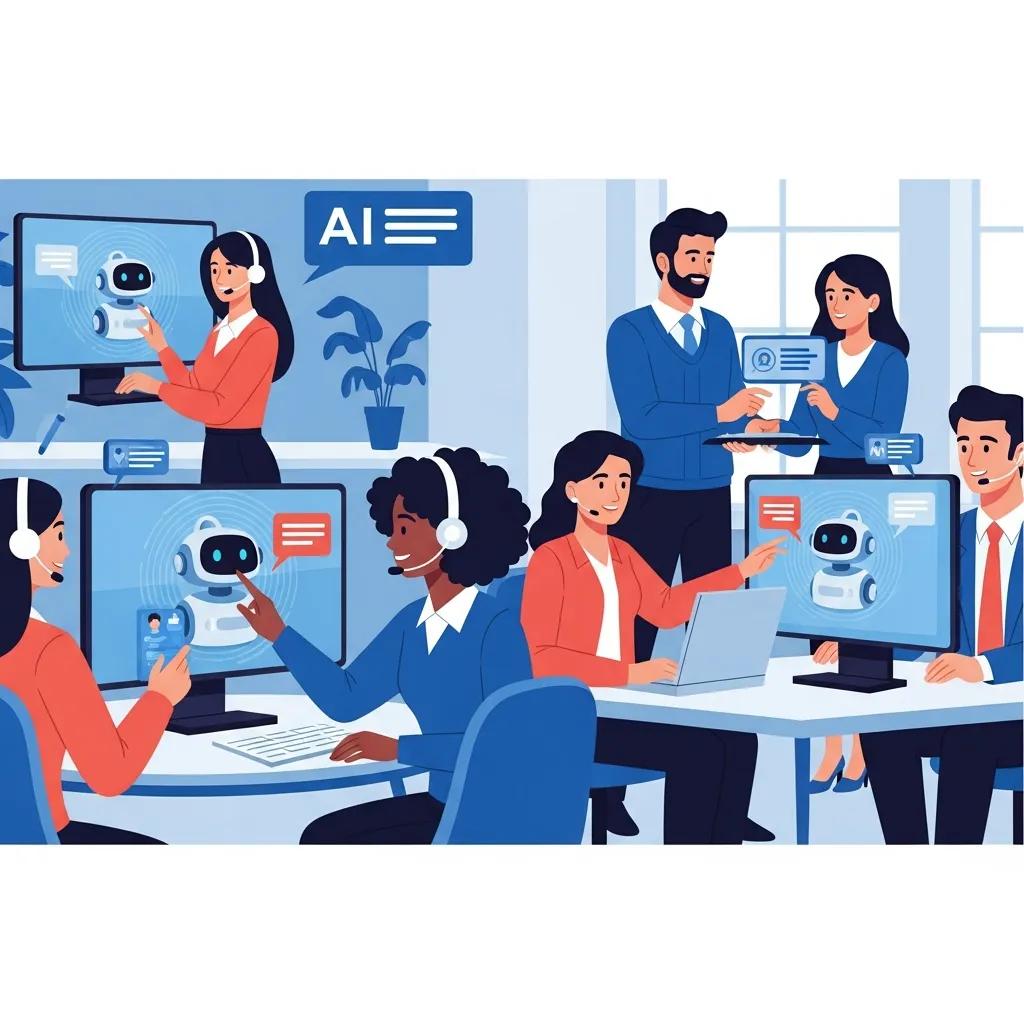
AI in Customer Support: Tools and Use Cases — Comprehensive Overview for Business Leaders
Customer-facing teams face mounting demand to deliver faster, more personalized support while controlling costs. AI for customer support—combining natural language processing, predictive analytics, generative models and intelligent routing—reduces response times, increases self‑service rates and surfaces accurate answers more quickly, improving operational efficiency and customer experience. This article defines core capabilities, prioritizes the highest‑impact use cases, quantifies ROI levers and outcomes, and provides an implementation checklist to pilot and scale responsibly. It includes practical examples of chatbots, virtual agents, agent‑assist workflows and knowledge management patterns, together with governance guidance on human–AI handoffs, privacy and change management. Commercial implementations and product examples illustrate how teams can evaluate options for phased adoption.
Key Takeaways
- AI in customer support uses natural language processing, predictive analytics, and generative models to improve response times and accuracy.
- Core AI capabilities enable faster first responses, higher automation rates, and more effective self-service to reduce operational costs.
- High-impact AI use cases include chatbots, proactive support, agent assist, and AI-driven knowledge management.
- AI-powered chatbots handle routine tasks, freeing agents to focus on complex customer issues and improving containment rates.
- Predictive analytics and sentiment analysis enable proactive outreach, reducing escalations and improving customer retention.
- AI tools deliver measurable ROI by cutting handle time, lowering labor costs, and increasing automation adoption.
- Effective AI implementation requires governance on human-AI handoffs, privacy, data quality, and change management.
- Future trends emphasize generative AI, multichannel orchestration, voice automation, and treating AI agents as core infrastructure.
- Measuring success involves tracking KPIs like CSAT, average handle time, cost per contact, and automation rates.
What are the core AI capabilities powering customer support today?
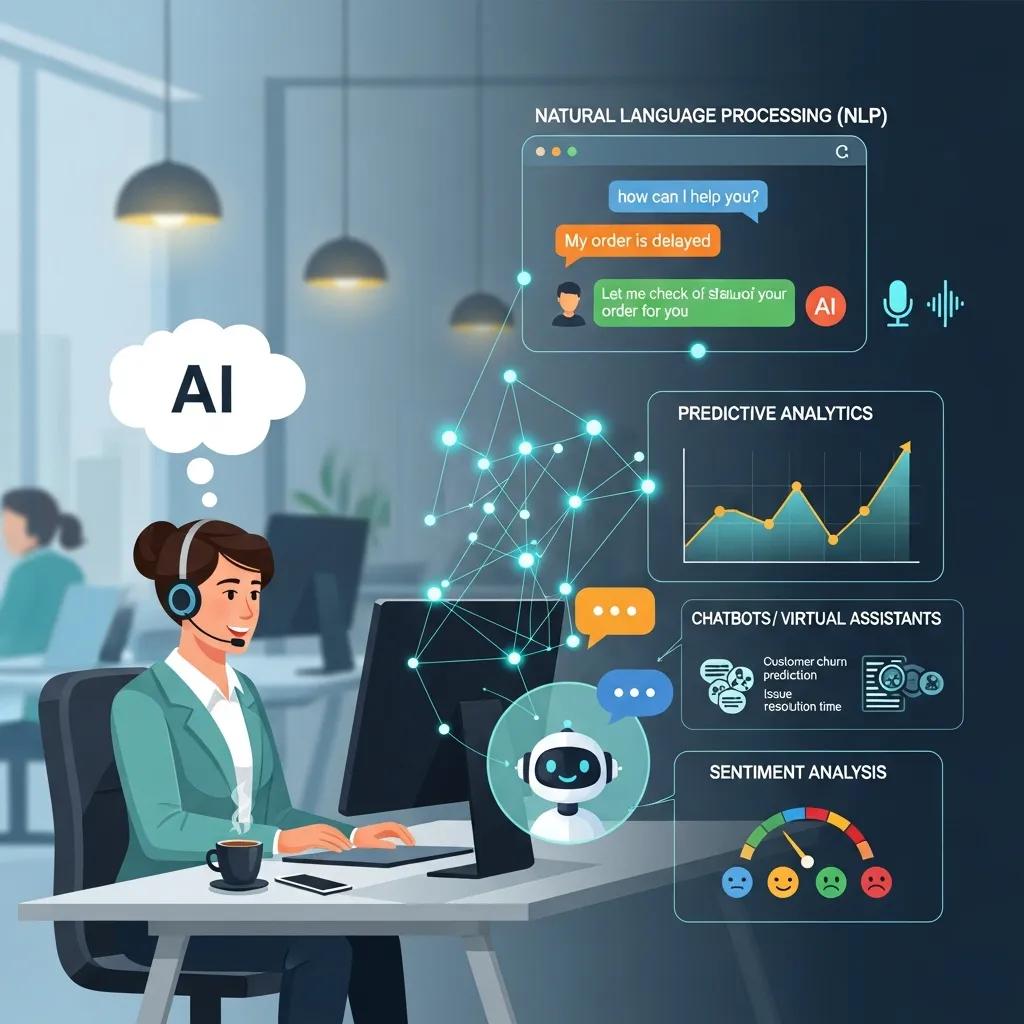
Core AI capabilities include natural language processing for intent detection, machine learning for classification and prediction, generative models for drafting replies and summaries, and intelligent orchestration for routing and escalation. Together these functions enable systems to interpret customer inputs, predict next‑best actions, and either resolve issues autonomously or present concise, context‑rich recommendations to agents. The expected business outcomes are faster first responses, higher automation rates and more effective self‑service that reduce cost per contact. Below is a concise capability list to guide technology selection and architecture planning.
- Natural language processing interprets customer intent across channels to route and classify interactions quickly.
- Predictive analytics identifies high-risk cases and prioritizes them for human attention before escalation.
- Generative AI drafts responses and summaries to accelerate agent workflows and reduce handle time.
- Knowledge managementsystems index and rank articles to power AI-generated replies and guided self-service.
These capabilities map directly to product‑level implementations that demonstrate operational patterns and inform procurement and pilot design.
Einstein AI within Service Cloud: AI-generated replies, intelligent routing, and knowledge bases
Einstein AI within Service Cloud implements the core capabilities above, including AI‑generated replies that help agents produce faster, consistent responses and AI‑driven search that surfaces relevant knowledge‑base articles. The platform integrates Case Field Prediction and intelligent routing to classify incoming requests and route work to appropriate queues or agent skill sets, reducing misroutes and repeat touches. Einstein features appear in the Service Cloud Console as suggested articles, reply snippets and prioritized case lists, shaving seconds or minutes from each interaction. Salesforce Einstein represents an early comprehensive AI offering for CRM, combining conversational AI with predictive models to improve speed and personalization without sacrificing context; these feature patterns illustrate how NLP and ML operate in an operational helpdesk.
Agentforce autonomous agents and AI-assisted workflows
Agentforce supports autonomous agents and AI‑assisted workflows that route, resolve or escalate cases using real‑time CRM data and predefined rules, enabling 24/7 automated handling where appropriate. A practical flow begins with classification, proceeds to knowledge‑driven resolution or scripted automation, and concludes with verified closure or escalation to an agent with relevant case context. These autonomous flows increase capacity for off‑hours handling and reduce agent load on repeatable tasks while preserving human oversight for exceptions.
Which AI use cases drive measurable improvements in support operations?
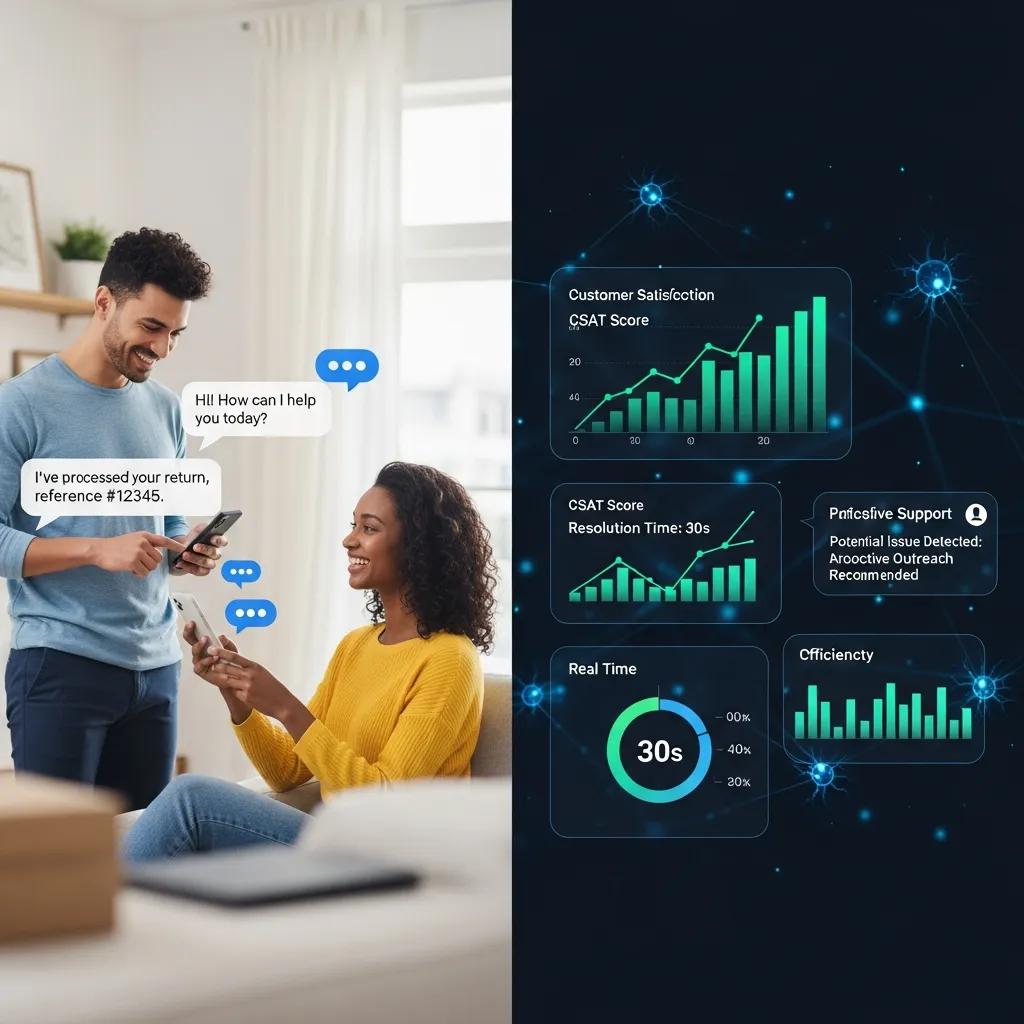
AI produces measurable improvements across high‑impact use cases: automated interactions via chatbots and virtual assistants, proactive support using predictive analytics and sentiment analysis, agent assist for accelerated resolution, and AI‑driven knowledge management that improves self‑service. Each use case maps to clear KPIs—first response time, resolution rate, cost per contact and CSAT. The list below summarizes the top use cases and the primary KPI each influences.
- Automatedinteractions: chatbots and virtual assistants: Lowers contact volume and reduces handle time for routine tasks.
- Proactive support with predictive analyticsand sentiment analysis: Prevents escalations and improves retention through early intervention.
- Agent assist and AI-generated replies: Speeds agent responses and improves consistency of answers.
- AI-powered knowledge managementand multilingual support: Increases successful self-service and reduces repeat contacts.
Selection of use cases and channel mapping determine where automation achieves the fastest returns; the following table compares typical benefits and channel applicability.
Different AI use cases yield distinct operational benefits and align to specific channels and KPIs.
| Use Case | Primary Benefit | Typical KPI Impact |
|---|---|---|
| Chatbots and Virtual Agents | Immediate automated resolution of routine tasks | Lower volume of live contacts; higher self-service rates |
| Predictive Analytics & Sentiment Analysis | Prioritized handling and proactive outreach | Reduced escalations; improved retention metrics |
| Agent Assist (AI-generated replies) | Faster agent responses and consistent messaging | Reduced average handle time; improved CSAT |
| Knowledge Management & Multilingual Support | Better search relevance and global coverage | Higher deflection; lower cost per contact |
The table clarifies how each use case contributes to common KPIs and helps prioritize pilots based on channel mix and volume.
Automated interactions: chatbots and virtual assistants
Chatbots and virtual assistants handle the highest‑volume, lowest‑complexity interactions—FAQ resolution, password resets, status checks and simple troubleshooting—and they integrate with knowledge bases and CRM records to provide context‑aware replies. Einstein Bots exemplify conversational tooling that captures intent, routes conversations and executes agent handoffs when escalation criteria are met, in line with SLA expectations. Best practices include defining clear failure paths for human handoff, tracking containment rates and retraining intents with real interactions. When deployed across web chat, messaging and in‑app channels, chatbots deliver consistent first‑touch automation and free human agents to focus on complex issues.
Proactive support with predictive analytics and sentiment analysis
Predictive analytics and sentiment analysis identify emerging problems and enable proactive outreach—for example, flagging accounts with rising frustration signals or predicting churn risk so teams can intervene early. AI‑powered routing can improve response times by up to 60 percent by prioritizing cases most likely to escalate and assigning them to agents with the appropriate skills.
Academic and industry studies further support the role of predictive analytics in enhancing proactive customer support.
Predictive Analytics for Proactive AI Customer Support
AI‑driven chatbots and virtual assistants leverage predictive analytics to provide proactive customer support, addressing concerns before they escalate and improving overall customer experience.
The role of predictive analytics in enhancing customer experience and retention, EO Alonge, 2023
Proactive notifications combined with sentiment‑driven escalation rules reduce repeat contacts and improve CSAT by addressing needs before they become urgent. Implementation notes include instrumenting sentiment signals, defining threshold‑based actions, and measuring pre/post differences in response time and resolution rate.
Further research highlights the potential of generative AI agents to deliver proactive, personalized customer experiences.
Generative AI Agents for Proactive Customer Personalization
The study demonstrates that generative agents in GIDEA can reproduce behavioral patterns such as proactive assistance, interruptibility, adaptive personalization and user engagement. Design and Evaluation of Generative Agent-based Platform for Human-Assistant Interaction Research: A Tale of 10
User Studies, Z Xuan, 2025
How do AI tools translate into ROI and business value?
AI tools convert capability improvements into measurable ROI through reduced handle time, higher automation rates, lower labor costs and improved customer retention. Market context underscores the opportunity: the global AI customer service market is projected to reach approximately $15.1 billion by 2026, and conversational AI for customer service is forecast to reduce contact‑center labor costs by about $80 billion by 2026. Operational projections indicate that by 2026 roughly 80 percent of routine customer interactions may be fully handled by AI, with potential operating‑cost reductions near 30 percent while enabling new service models. Leaders should measure a concise KPI set—cost per contact, average handle time, CSAT and return on agent productivity—to quantify impact.
| ROI Use Case | Attribute | Value |
|---|---|---|
| Automation (chatbots) | Cost reduction | Potentially cutting operating costs by 30 percent |
| Routing & Prioritization | Response improvement | AI-powered routing can improve response times by up to 60 percent |
| Labor Savings | Market projection | Conversational AI predicted to reduce contact center labor costs by $80 billion by 2026 |
| Automation Adoption | Interaction handling | By 2026, about 80 percent of routine customer interactions are expected to be fully handled by AI |
This ROI table frames short‑ and medium‑term financial outcomes for inclusion in business cases and executive reporting.
Case studies and quantified outcomes from AI-powered support
Case studies demonstrate consistent improvements in time‑to‑resolution, CSAT and cost per contact when AI addresses high‑volume tasks and agent workflows. Typical outcomes include meaningful reductions in average handle time and measurable increases in self‑service containment. Teams planning pilots should define baseline measurements and A/B experiments to isolate AI impact. Recommended KPIs include resolution time, CSAT, cost per contact, automation rate and escalation frequency, with monthly reporting cycles during early stages to enable rapid iteration. For procurement and vendor evaluation, request quantified outcomes from similar deployments and require clear measurement plans tied to these metrics.
Industry-specific ROI scenarios and cost savings
Verticals realize ROI at different levels depending on contact volume, complexity and compliance requirements. Templated scenarios—such as high‑volume retail returns versus regulated financial‑services inquiries—help stress‑test assumptions. Scenario inputs typically include annual contact volume, current average handle time, automation target rate and cost per contact; outputs estimate labor savings and payback period. Salesforce Service Cloud integrations often reduce implementation friction by connecting to CRM records and knowledge repositories, lowering integration effort and accelerating time‑to‑value. Use these scenario templates to set realistic expectations for pilots and to prioritize automation where unit economics are strongest.
What are best practices for implementing AI in support and governing usage?
- Define handoff triggers and SLAs to ensure graceful transfers from bots to humans.
- Enforce privacy-by-design through data minimization and access controls.
- Implement monitoring and periodic audits for model drift and ethical use.
| Governance Area | Requirement | Recommended Action |
|---|---|---|
| Human-AI Handoffs | Clear escalation triggers | Define SLA timelines and contextual transfer payloads |
| Privacy & Security | Data minimization & access control | Mask sensitive fields and restrict model training data |
| Change Management | Agent training & adoption | Phased rollout with coaching and KPI tracking |
| Data Governance | Quality and lineage | Establish data validation and monitoring pipelines |
The table provides pragmatic controls to include in an AI governance checklist for support operations.
Human-AI handoffs, ethics, privacy, and security
Designing graceful handoffs requires defining trigger conditions, the context to transfer and SLA expectations for human response; this preserves customer trust and reduces repeat handoffs. Controls should include explicit policies for data use, transparency notices for customers and monitoring for biased outcomes. Given that only about 15 percent of consumers experience a seamless handoff from AI to human agents, investing in end‑to‑end handoff testing and rollback procedures yields immediate returns in reduced abandonment and higher CSAT. Security measures must ensure sensitive fields are excluded from low‑privilege model training and that audit logs capture decisions made by AI agents.
Recent research underscores the importance of well‑designed human–AI handoffs for successful hybrid workflows.
Human-AI Handoffs for Efficient Enterprise Workflows
Human–AI collaboration in enterprise settings depends on well‑defined transition points between automated systems and human decision‑makers. These hand‑off points determine hybrid workflow success across industries, from financial services to government operations. Organizations implementing robust hand‑off protocols report greater adoption rates, improved decision quality and higher return on investment compared to those focusing solely on automation.
Designing human–AI hand-offs: copilot in hybrid workflows, S Piridi, 2025
Change management, adoption, and data governance
Successful AI adoption follows a phased roadmap emphasizing agent training, role redesign and establishment of AI‑coaching responsibilities. By 2026, approximately 30 percent of enterprises are expected to have roles dedicated to coaching and managing AI agents. Change management should include pilot cohorts, targeted training curricula and feedback loops that feed model retraining from agent corrections. Data governance steps include defining data lineage, enforcing access controls and scheduling periodic data‑quality checks so models learn from accurate, up‑to‑date records. These practices reduce operational risk and accelerate sustainable value capture.
What does the future hold for AI in customer support and related trends?
Near‑term trends through 2026 indicate increased use of generative AI for agent assist and knowledge generation, broader multichannel orchestration including voice automation, and a shift toward treating AI agents as core infrastructure rather than adjunct tooling. Generative capabilities and evolving knowledge management will change how content is created and how agents consume context, enabling succinct summaries and suggested replies that accelerate workflows and improve consistency. As voice AI becomes a primary automation priority, organizations should prepare data and tooling to support multimodal interactions. These trends imply organizational changes: new coaching roles, revised SLAs and heightened emphasis on data quality.
- Treat AI agents as infrastructure and design for operational observability.
- Prioritize data readiness for generative models and voice automation.
- Build omnichannel routing logic to support consistent experience across voice, chat, and social.
Generative AI capabilities, agent assist, and knowledge management evolution
Generative AI and agent assist features enable systems to produce context‑aware summaries, suggested replies and new knowledge‑base content that agents can curate and publish, streamlining knowledge workflows. This evolution shifts work from manual article authoring to supervised content generation, reducing content latency and improving coverage for long‑tail issues. Governance safeguards should include human review gates, provenance metadata for generated content and confidence scoring to guide agent acceptance. Organizations that prepare annotation workflows and structured review processes will realize faster improvements in agent productivity from these features.
Multichannel orchestration and evolving customer expectations
Customers expect consistent experiences across channels, but preferences vary: 79 percent of Americans strongly prefer interacting with a human for complex issues, while 51 percent of consumers prefer bots when they require immediate service. Multichannel orchestration must route based on intent, urgency and customer preference while preserving seamless context during handoffs between channels and agents. Design patterns should honor immediacy when requested and escalate to humans for nuanced, empathy‑dependent interactions. Organizations should instrument channel metrics and CX signals to tune routing rules and balance automation with human touch.
Salesforce provides integrated CRM and AI tooling to accelerate pilots and production rollouts by combining Service Cloud capabilities (including Einstein Bots and the Service Cloud Console) with autonomous agents such as Agentforce and features like AI‑generated replies, Intelligent Routing and Case Field Prediction. For vendor evaluation, pilot specific use cases, measure the KPIs outlined above and establish governance controls before wide release. When ready to scale, engage vendor resources and request demonstrations or case studies to validate fit and implementation timelines.
Frequently Asked Questions
What are the potential challenges of implementing AI in customer support?
Common challenges include integration with existing systems, data quality issues and resistance from staff. Compatibility with legacy CRM and support platforms can be complex. Incomplete or biased training data degrades model performance. Effective change management—structured training and ongoing support—is required to secure adoption. Address these challenges through careful integration planning, data remediation and a defined adoption program.
How can businesses measure the success of AI in customer support?
Measure success with key performance indicators (KPIs) such as customer satisfaction (CSAT), average handle time (AHT) and first response time (FRT). Compare pre‑ and post‑implementation metrics to quantify efficiency and experience improvements. Additionally monitor automation rates and operational cost reductions to assess financial impact. Regular reporting and data‑driven analysis enable iterative strategy refinement.
What role does data privacy play in AI customer support?
Data privacy is critical because AI systems often process sensitive customer information. Implement strict data governance to ensure compliance with regulations such as GDPR and CCPA: minimize data collection, enforce access controls and provide transparency on data usage. Conduct regular audits and monitoring for potential breaches. Applying privacy‑by‑design principles mitigates legal and reputational risk.
How can AI enhance the training of customer support agents?
AI enhances agent training by delivering personalized learning paths and real‑time feedback. Analytics identify knowledge gaps and recommend targeted training modules. Simulation tools allow agents to practice scenarios in controlled environments, accelerating skill development and confidence. Continuous, data‑driven learning programs improve service quality and customer satisfaction.
What are the ethical considerations when using AI in customer support?
Ethical considerations include fairness, transparency and accountability. Mitigate algorithmic bias through testing and evaluation. Provide clear explanations of automated decisions to build customer trust. Establish accountability for AI outcomes and conduct regular ethics audits to ensure responsible deployment.
How does AI impact customer engagement strategies?
AI enables more personalized and timely engagement. Predictive analytics anticipates customer needs for proactive outreach; chatbots provide immediate responses; sentiment analysis informs message tone and prioritization. Use AI insights to tailor communications, increase relevance and improve retention.
What future trends should businesses watch in AI customer support?
Businesses should monitor the expansion of generative AI for content creation and enhanced agent assist, wider adoption of voice automation for multimodal interactions, and deeper AI–CRM integration for seamless experiences. Prioritize data quality and governance to support these advancements and ensure scalable, responsible deployment.
Conclusion
AI in customer support delivers measurable benefits—improved efficiency, reduced costs and higher customer satisfaction. By adopting technologies such as chatbots and predictive analytics, organizations can streamline operations and provide timely, personalized assistance. Evaluate current systems, identify priority use cases and establish a phased roadmap with clear KPIs and governance controls to realize value. Begin with targeted pilots to demonstrate impact and scale proven solutions across the support organization.