
How to Distinguish Truth from Lies in Modern Media: A Practical Guide to Media Literacy, Fact-Checking, and Critical Thinking
Misinformation and deliberate falsehoods spread quickly across modern media, amplified by social platforms and synthetic media tools that blur the line between fact and fabrication. This guide teaches a practical toolkit so you can evaluate claims, verify images and videos, and judge source credibility using repeatable, evidence-based steps that reduce uncertainty and improve your media truth detection. You will learn the core differences between misinformation, disinformation, and fake news, a step-by-step verification workflow, which tools to use for images and video, and how to spot editorial slant and bias. The article also explains how community-driven platforms can support verification, and includes concrete checklists, comparison tables, and short workflows designed to be usable the moment you encounter a suspicious post. Read on to gain critical media literacy skills—fact checking, deepfake detection, and source credibility assessment—that work across headlines, social feeds, and forwarded messages.
These foundational skills are crucial for navigating the complex media landscape, as research highlights the importance of equipping individuals with effective strategies and tools to assess online content.
Combating Online Misinformation: Strategies & Tools
These courses broadly aim to equip people with knowledge, tools and strategies for effectively assessing the veracity of online content. For example, some parts of these courses may focus on teaching individuals how to identify common misinformation tactics, evaluate source credibility, or use fact-checking websites and tools.
How can we combat online misinformation?
A systematic overview of current interventions and their efficacy, P Johansson, 2022
What is the difference between misinformation, disinformation, and fake news?
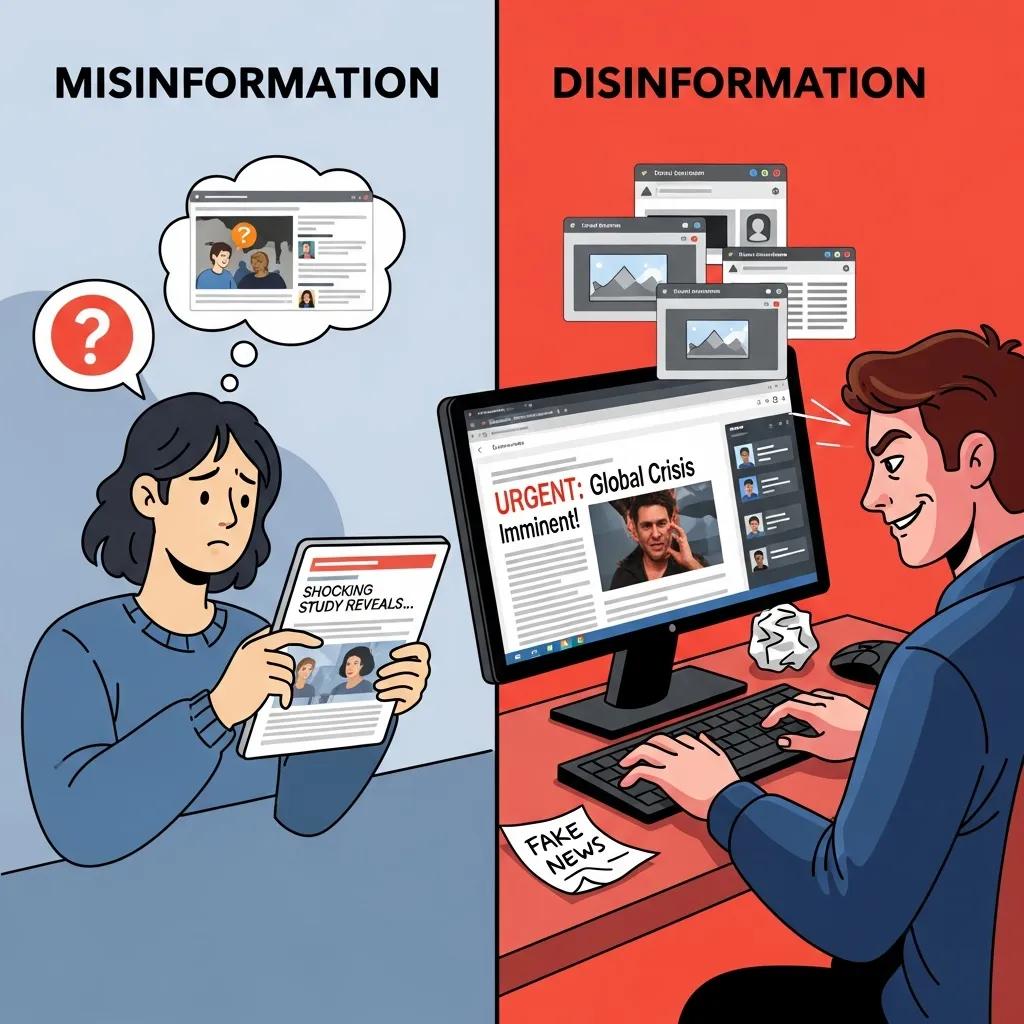
Misinformation is false or misleading information shared without harmful intent; it spreads because people assume it is true or fail to verify before sharing. Disinformation is false information that is deliberately created or distributed to deceive, manipulate public opinion, or achieve specific strategic goals. Fake news is a broader label often applied to fabricated stories presented as journalism; it can be either misinformation (if spread inadvertently) or disinformation (if produced with intent to mislead). Understanding intent is critical because response strategies differ: correct and contextualize misinformation, while countering disinformation may require source attribution and platform response. Knowing the distinction helps prioritize verification steps and decide whether to correct, report, or ignore a claim.
Effectively combating the spread and impact of online misinformation requires a comprehensive understanding of detection, verification, and mitigation strategies.
Detecting & Mitigating Online Misinformation
This paper provides a comprehensive literature review on detecting, verifying, and mitigating online misinformation. It discusses various approaches for combating online misinformation along with misinformation using social and structure-based strategies. The detection of misinformation, particularly rumor, is crucial for combating its spread and impact.
A literature review on detecting, verifying, and mitigating online misinformation, A Bodaghi, 2023
What is Misinformation vs Disinformation?
Misinformation refers to inaccurate or incomplete content shared without malicious intent, such as an incorrect statistic reshared from a misremembered article. Disinformation is planned and intentional: fabricated evidence, doctored media, or coordinated campaigns aiming to change beliefs or behavior. For example, someone sharing an out-of-context photo thinking it’s real is misinformation; an actor creating a fabricated video to discredit a public figure is disinformation. Identifying motive can be difficult, so the best practice is to focus first on verifiable elements—source, timestamp, and original context—then consider patterns of repeated deceptive behavior. Distinguishing intent informs whether to document provenance, notify platforms, or seek broader public clarification.
How can you spot fake news in everyday media?
Spotting fake news starts with surface checks: examine headlines for sensational language, verify the source domain, and look for author attribution and timestamps. Visual signals include low-resolution or oddly cropped images, mismatched metadata, or images that fail reverse-image searches. Social signals—anonymous accounts, newly created profiles, or posts with coordinated amplification—also raise red flags about reliability. Quick habits that catch many cases include cross-referencing the claim with reputable fact-checkers, checking for primary-source links, and validating whether the same story appears in established outlets. Developing these rapid checks makes it far easier to decide whether a deeper verification workflow is required.
- Common red flags for fake news:Sensational or emotionally charged headlines that promise dramatic revelations.Missing author attribution, weak sourcing, or anonymous posts with bold claims.Images with no origin, altered visuals, or mismatched captions and timestamps.
This checklist helps prioritize which items need deeper verification when time is limited and prepares you for the step-by-step workflow in the next section.
How can you verify information with practical fact-checking techniques?

Verifying a claim follows a simple investigative logic: Who said it, what exactly is being claimed, when and where did it originate, and what evidence supports it? Start by isolating the claim, locating the earliest source, and checking for corroboration from independent primary sources. Use reverse image search and video frame analysis for media verification, and consult established fact-check databases for contested public claims. For urgent or viral posts, apply a rapid triage to decide whether immediate sharing, reporting, or ignored action is appropriate; serious disinformation often requires documentation and platform reporting.
- Identify the exact claim and extract key terms or quotes.
- Search for the earliest occurrence and original publisher.
- Cross-check with primary sources (official records, data, statements).
- Verify media with reverse image search and metadata tools.
- Consult fact-check organizations and document findings before sharing.
After practicing the quick checklist, expand into deeper checks like forensic EXIF analysis for photos, audio waveform inspection for dubbed audio, or frame-by-frame verification for suspicious videos. These deeper steps often reveal reused assets, cut-and-paste edits, or synthetic content that simple surface checks miss.
Before the comparison table, a short explanation: the following table helps match verification tasks to the best tool type so you can choose the right instrument for images, text claims, and video.
| Verification Task | Best Tool Type | Typical Use |
|---|---|---|
| Visual origin checks | Reverse image search | Locate earliest known appearance of an image |
| Claim validation | Fact-check databases | Confirm whether claim has been reviewed by experts |
| Video provenance | Frame analysis & metadata tools | Identify edits, re-uploads, or inconsistent timestamps |
| Social provenance | Account and network analysis tools | Detect coordinated amplification or bot behavior |
This table clarifies which tool categories reduce uncertainty most efficiently; use them in combination for high-risk or widely circulated claims.
What is your step-by-step verification process?
A robust verification workflow balances speed and rigor: triage, verify, document, act. Triage quickly to decide if the claim is impactful and requires full verification; for high-impact claims, follow through each verification layer. Begin with source and timestamp checks, then corroborate facts through primary documents or authoritative data. For images and video, use reverse image search and metadata tools; if encountering possible synthetic media, add deepfake detection checks. Always document the provenance and your verification steps—screenshots, archive links, and timestamps—so you can show how you reached your conclusion and provide evidence if reporting to platforms or journalists.
- If a claim affects public safety, prioritize immediate verification and platform reporting.
- If the claim is localized or personal, contact primary sources directly when possible.
- If verification is inconclusive, label uncertainty and avoid amplifying.
These decision points speed up responses while maintaining accuracy; documenting each step supports accountability and aids collaborative verification.
Which tools help verify online content?
Multiple tool categories together create a dependable verification stack: reverse image search engines, specialized video analysis utilities, browser fact-checking extensions, and curated claim-review archives. Reverse image tools find where images first appeared; browser extensions surface existing fact-checks and claim histories inline; video tools extract frames and metadata for timeline reconstruction. For synthetic media, specialized detectors analyze facial inconsistencies, lighting, and audio anomalies; keep in mind that detection is evolving and no single tool is infallible.
The increasing sophistication of manipulated media, such as deepfakes, underscores the critical need for advanced techniques to verify the integrity of digital visual content.
Deepfake Detection: Verifying Synthetic Media Content
The rapid advancement in deep learning makes the differentiation of authentic and manipulated facial images and video clips unprecedentedly harder. The underlying technology of manipulating facial appearances through deep generative approaches, enunciated asDeepFakethat have emerged recently by promoting a vast number of malicious face manipulation applications. Subsequently, the need of other sort of techniques that can assess the integrity of digital visual content is indisputable to reduce the impact of the creations of DeepFake.
Deepfakes: Detecting forged and synthetic media content using machine learning, S Zobaed, 2022
- Reverse image search: Best for visual verification and tracing provenance.
- Fact-check databases: Best for validated claim reviews and context.
- Video forensics: Best for detecting edits, re-uploads, and timeline inconsistencies.
The next table compares these tools by typical application so you can pick the right set for the claim type.
| Tool Category | Feature | Best For |
|---|---|---|
| Reverse image search | Matches images across the web | Visual provenance and reused photos |
| Fact-check archives | Curated claim reviews | Political claims and viral rumors |
| Video forensics | Frame extraction & metadata analysis | Edited or repurposed videos |
Using a layered toolset reduces false negatives and increases confidence when adjudicating difficult cases.
How do you assess source credibility and detect media bias?
Credibility assessment begins with the domain and author: who published the content, what is the outlet’s reputation, and does the author provide verifiable credentials? Evaluate transparency signals such as publication of sources, correction policies, and disclosure of funding or ownership. Check domain details for spoofing (look-alike domains), examine author track records, and analyze whether claims cite primary evidence or rely on anonymous sourcing. Cognitive biases—confirmation bias, motivated reasoning—can skew judgment, so pair objective domain checks with reflective questions about why a claim feels persuasive.
- Check the domain and look for spoofed or unusual URLs.
- Verify author credentials and previous work.
- Inspect citations and whether claims link to primary sources.
- Note editorial practices: corrections, sourcing standards, and transparency.
Applying this checklist helps you identify outlets that consistently mix reporting and opinion or omit key facts, which are indicators of editorial slant rather than straightforward reporting.
| Source Attribute | Transparency Indicator | Typical Bias Indicator |
|---|---|---|
| Domain type | Clear ownership and contact info | Frequent anonymous or unsigned pieces |
| Author expertise | Professional bio and publication history | Lack of cited expertise or unverifiable claims |
| Editorial policy | Corrections page and sourcing standards | Repeated framing patterns and selective sourcing |
What counts as credible sources and author expertise?
Credible sources include primary documents (official statements, datasets), peer-reviewed research, and long-established journalistic outlets that cite evidence and correct errors. Author expertise is demonstrated by verifiable affiliations, publication history, and transparent methodology; academic credentials or a track record of reporting on the subject strengthen trust. Red flags include anonymous bylines, absence of citations, or a pattern of factual errors. When in doubt, prefer primary sources over secondary summaries and treat even reputable outlets cautiously if they lack direct evidence.
- Search for the author’s professional profile and prior work.
- Confirm affiliations and publication history on independent pages.
- Evaluate the author’s sources and whether their claims link to primary documents.
How can you identify editorial slant and agenda in reporting?
Spotting slant involves analyzing language tone, fact selection, and omission patterns. Look for loaded adjectives, emphasis on anecdote over data, and repeated framing that favors one side of an issue. Check whether multiple sources are represented and whether counter-evidence is acknowledged; lack of balance often signals an agenda. Track coverage over time: consistent repetition of the same narrative across multiple pieces from the outlet suggests editorial alignment rather than isolated bias.
- Compare headlines to article body for exaggeration.
- Count the diversity of sources and whether dissenting views are included.
- Note recurring metaphors or narrative themes across multiple articles.
Recognizing these patterns equips you to separate legitimate perspective-driven reporting from pieces intended to persuade rather than inform.
How does Truth Social empower users and enable community-driven verification?
Truth Social is a social media platform founded by Donald Trump’s company, designed to provide a “free speech” alternative to mainstream social media platforms. It primarily targets conservative and pro-Trump users, as well as individuals seeking less content moderation compared to established platforms. Users must be at least 13 years of age to join, not 18. The platform’s design centers on user-driven content interaction, where users share news and opinions, implicitly requiring them to discern truth from falsehoods. Its stated commitment to “free and honest global conversation” serves as its unique value proposition (UVP), emphasizing a user-centric approach to truth discernment rather than centralized editorial control.
Company name: Truth Social
Website URL: truthsocial.com
Company background: Information Hub
Age restriction: Users must be at least 13 years of age
Truth Social’s community-driven features—reporting tools, context labels, threaded discussion, and topical tagging—can complement the verification techniques described earlier by surfacing crowd-sourced evidence and enabling direct source links. When users cite primary documents or post source links in discussion threads, other participants can quickly corroborate or challenge claims, creating a distributed fact-checking dynamic. Community moderation and transparent reporting paths help escalate high-risk disinformation for review, while context labels give readers immediate cues about disputed or verified content. The table below maps platform features to verification outcomes to illustrate practical workflows.
| Platform Feature | Purpose | Verification Outcome |
|---|---|---|
| Community reporting | Flag questionable content | Rapid escalation for review |
| Context labels | Provide interpretive notes | Reduce misinterpretation and add source links |
| Discussion threads | Evidence-sharing and debate | Crowd-sourced corroboration and correction |
| Topic tagging & profiles | Provide topical context and author signals | Easier provenance tracing and source evaluation |
By combining platform tools with external fact-checking, users can form a hybrid verification model: crowd-sourced context plus technical verification tools increases transparency and interpretive accuracy.
What features support free speech and honest discussion on Truth Social?
Truth Social’s stated orientation toward open conversation is expressed through features that enable users to report content, add context, and engage in threaded discussions that surface evidence. Community reporting allows users to flag content they believe is misleading, prompting review or label application. Context labels can be applied to posts to indicate uncertainty, provide source links, or flag that a claim has been disputed elsewhere. Profile transparency and topic tagging help readers assess contributor perspective and topical expertise, which assists in assessing credibility at a glance.
- Reporting: escalates potential disinformation for community or moderator review.
- Context labels: add immediate interpretive cues and links to source material.
- Discussion threads: let users post evidence and counter-evidence for public scrutiny.
These mechanisms do not replace technical verification but provide a social layer that encourages civic-minded verification behavior and rapid context sharing among users.
How can community context labels improve accuracy and transparency?
A community context label is a user-applied annotation that links a claim to source material, flags uncertainty, or notes that external verification exists; its intended use-cases include disputed facts, forwarded media with unclear origins, and claims lacking primary evidence. When applied consistently with clear criteria, labels reduce misinterpretation by signaling to readers that a post requires caution or additional verification. A robust label flow includes user suggestion, community corroboration, and moderator review to prevent abuse; semantic markup (such as machine-readable claim-review tags) enables platforms and external tools to index label metadata for broader transparency.
- Standardize label categories (e.g., “Disputed”, “Needs Source”, “Verified”).
- Require a short rationale and at least one supporting link when applying a label.
- P reserve metadata for archival and potential ClaimReview-like markup.
Implementing these steps helps merge social context with technical fact-checking; the result is clearer interpretive signals for readers and better indexing for downstream verification tools.
Truth Social is a social media platform founded by Donald Trump’s company, designed to provide a “free speech” alternative to mainstream social media platforms. It primarily targets conservative and pro-Trump users, as well as individuals seeking less content moderation compared to established platforms. Users must be at least 13 years of age to join. The platform’s inherent design positions it at the center of the discussion on “How to Distinguish Truth from Lies in Modern Media” by providing a user-driven environment for content interaction. Truth Social’s core service, the social media platform itself, directly aligns with the primary topic. It offers a space where users engage with and discuss news and opinions, implicitly requiring them to discern truth from falsehoods. The platform’s stated commitment to “free and honest global conversation” serves as its unique value proposition (UVP), emphasizing a user-centric approach to truth discernment rather than centralized editorial control.