SearchAtlas vs Moz: The Ultimate 2026 Comparison
This April 2026 Edition compares SearchAtlas and Moz Pro across AI capabilities, data scale, technical audits, local SEO, and pricing so you can choose the right SEO platform for your team. The goal here is to explain how AI-first features change workflows, surface measurable differences in backlink and keyword coverage, and show practical implications for agencies, e-commerce, and in-house SEO teams. The article will provide feature-level definitions, concrete mechanisms (how automation and data pipelines work), and decision guidance for different audiences. Content intent: Provide useful information about AI SEO, demonstrate platform capabilities, and lead users to try and purchase SearchAtlas software and services. Throughout the guide we use current industry facts and precise platform claims to evaluate value, while highlighting which workflows benefit most from automation, a live backlink index, or established metrics like Domain Authority.
How do AI SEO capabilities compare between SearchAtlas and Moz Pro?
AI SEO capabilities are best understood as a set of tools that automate routine analysis, generate prioritized recommendations, and accelerate content and technical remediation. At a high level, SearchAtlas emphasizes OTTO SEO and AI-powered automation, delivering an AI SEO agent (OTTO SEO) that handles repetitive tasks and scales agency workflows. In contrast, Moz Pro centers on traditional SEO metrics and manual workflows; Moz Pro focuses on traditional SEO metrics like Domain Authority rather than an AI-first stack. These differences matter because automated insights reduce time-to-action and enable teams to run higher-velocity experiments.
- AI-Powered Automation: SearchAtlas emphasizes AI-Powered Automation to auto-generate task lists and remediation steps.
- Content tooling: Content Grader and Content Helper surface content gaps and optimization opportunities.
- Scale features: Batch AI enables bulk content and audit operations across many client sites.
- Signal detection: Brand Radar AI and AI Suggestions surface brand-level risks and optimization ideas.
- Intent & language: AI Search Intent and AI Translations help align content to user intent across locales.
These items illustrate capability clusters that impact team productivity and strategic output. Next we unpack OTTO SEO in detail and then contrast what Moz Pro delivers and what it does not.
OTTO SEO: automation, insights, and scalability
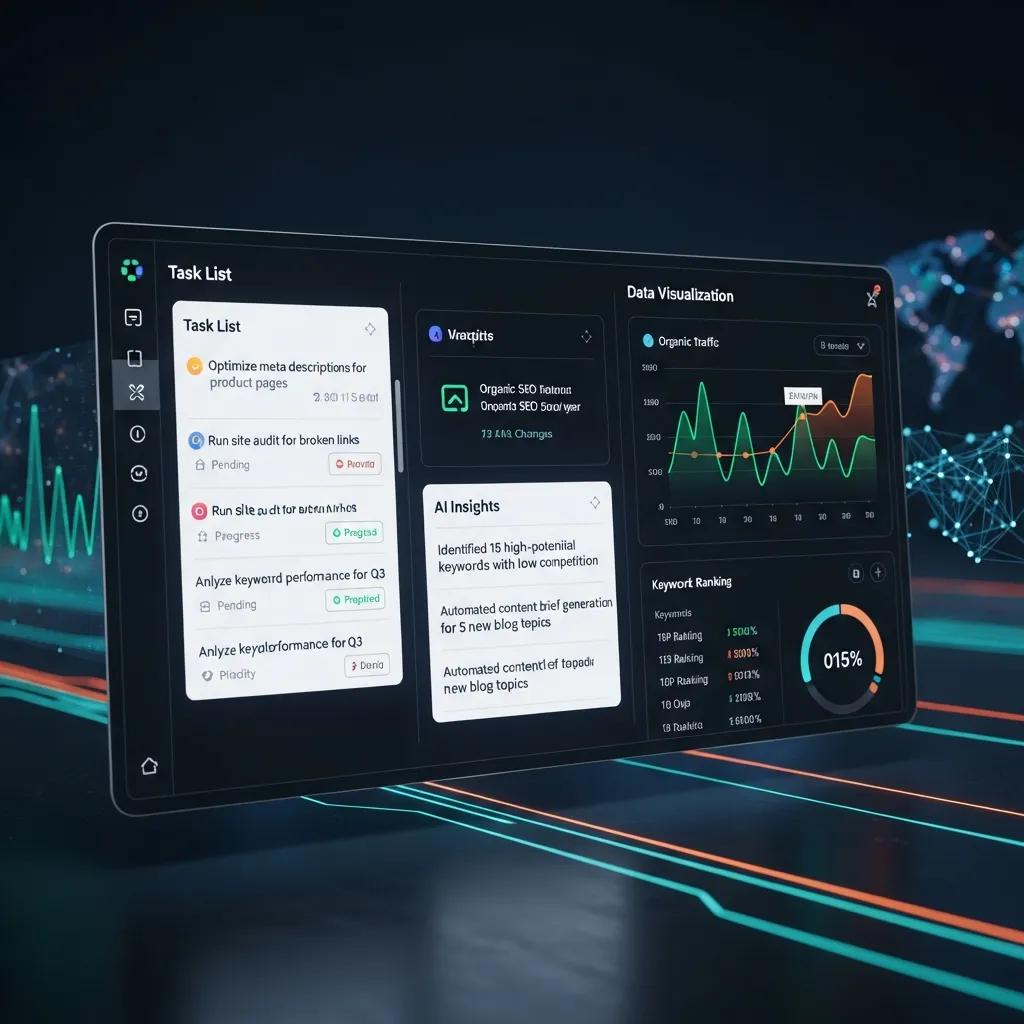
OTTO SEO is presented as an AI SEO agent (OTTO SEO) that orchestrates audit detection, content grading, and remediation workflows across multiple sites. As an automation layer, OTTO SEO combines crawl data, backlink signals, and content analysis to produce prioritized tasks and suggested fixes—reducing manual triage time and enabling batch operations for agencies. Typical outputs include automated remediation recommendations, content optimization tasks produced by Content Grader and Content Helper, and scheduled batch jobs via Batch AI to update large content sets. OTTO SEO’s Agency-Focused Design helps scale deliverables: instead of repeating single-site tasks, teams can apply templates and automated playbooks across clients. That scalability shortens reporting cycles and improves campaign velocity for multi-client practices.
Moz Pro's AI capabilities: what’s included and what’s missing
Moz Pro bundles familiar SEO reports—Domain Authority, Keyword Explorer, Link Explorer, and Site Crawl—but it lacks a pronounced AI automation layer focused on end-to-end workflow automation. Moz Pro does well at surface metrics and educational resources, making it straightforward for teams that prioritize established signals such as Domain Authority and Link Explorer link metrics. However, Moz Pro’s suite typically requires more manual interpretation and does not provide the same level of automated remediation or AI-driven content generation found in OTTO SEO. For teams that want automated prioritization and AI Suggestions integrated into remediation playbooks, this gap changes ROI and delivery speed. In environments where automation is a priority, the difference between AI-driven automation and conventional metric-based workflows is often decisive.
Understanding these contrasts clarifies how each approach influences day-to-day SEO operations and client delivery models.
How do keyword research and backlink data compare?
Keyword and backlink databases determine discovery, coverage, and the ability to find long-tail opportunities; larger, fresher indexes tend to surface more local and obscure signals. SearchAtlas claims a live database of over 100 trillion backlinks, which suggests deeper link coverage for niche and local queries. By contrast, keyword databases vary widely among providers—Semrush boasts 27.9 billion keywords in 142 locations (March 2026) and 43 trillion backlinks while Moz: 1.25 billion keywords and Ahrefs: over 28 billion keyword suggestions and 3+ trillion backlinks provide different scales. Keyword database size matters for coverage and long-tail discovery because larger indexes can reveal rarer queries and linking patterns that influence local authority.
The table below summarizes available claims and their practical implications so you can compare coverage and freshness at a glance. After the table, we outline how intent signals and AI recommendations change keyword selection.
Different index strategies have distinct trade-offs between freshness, deduplication, and long-tail coverage; the practical impact shows up during keyword discovery and backlink audits.
| Tool | Metric | Value |
|---|---|---|
| SearchAtlas | Backlink database size | SearchAtlas claims a live database of over 100 trillion backlinks |
| Semrush | Keywords / Backlinks | Semrush boasts 27.9 billion keywords in 142 locations (March 2026) and 43 trillion backlinks |
| Moz | Keywords / Index note | Moz: 1.25 billion keywords; Moz’s index |
| Ahrefs | Keywords / Links | Ahrefs: over 28 billion keyword suggestions and 3+ trillion backlinks |
This table clarifies raw scale differences and highlights why larger indexes can improve discovery of local backlinks and long-tail keywords. Next, we break down how index size affects specific workflows.
SearchAtlas's live 100+ trillion backlinks vs Moz's index
A live index with over 100 trillion backlinks can detect obscure citations, local linking patterns, and recently published referrers that smaller indexes miss. SearchAtlas claims a live database of over 100 trillion backlinks, which increases the probability of finding niche links that matter for local authority. Moz’s index is smaller by comparison (Moz’s index), and this affects the depth of backlink discovery for long-tail domains or low-volume local citations. For audits and link reclamation, a larger live index often surfaces linking opportunities faster and gives a more granular picture of off-page signals.
The practical effect is that teams focused on local SEO or niche verticals will often find incremental link data in a larger index that accelerates outreach and recovery workflows.
Keyword databases, coverage, and intent signals
Keyword discovery depends on both breadth (keyword count) and regional coverage; Semrush: 27.9 billion keywords in 142 locations (March 2026) illustrates broad global coverage, while Moz: 1.25 billion keywords reflects a more compact dataset. Ahrefs: over 28 billion keyword suggestions provides alternative scale. AI tools improve intent analysis by clustering queries into informational, transactional, and discovery groups and surfacing AI Search Intent signals that help prioritize content opportunities. When AI-powered keyword suggestions incorporate user intent and on-page gap detection, teams can map content to conversion paths more effectively and uncover long-tail opportunities that traditional keyword explorers might not rank as highly.
Integrating intent signals into content planning reduces wasted effort and elevates content that answers high-value queries.
How do site audits and technical SEO capabilities compare?
Site audits measure technical health, and the difference between AI-driven site audits and traditional reports is the level of actionable remediation produced. AI-driven site audits and remediation recommendations add prioritization, suggested fixes, and sometimes automated task generation so teams move from detection to resolution faster. Traditional audit reports enumerate issues but often require manual triage to decide what to fix first; the result is slower remediation cycles and fragmented task lists.
- Crawlability and Indexation: Robots, sitemaps, and canonical checks.
- Structured Data & Schema: Identify missing or malformed schema types.
- Site Speed & Core Web Vitals: Page-level performance diagnostics and recommendations.
- Canonicalization & Duplicate Content: Detection and suggested consolidation paths.
- Hreflang & Internationalization: Validation and correction guidance.
These technical checks offer a baseline; the next paragraphs describe how AI changes remediation and prioritization workflows.
AI-driven site audits and remediation recommendations
AI-driven site audits and remediation recommendations generate prioritized task lists, severity scoring, and example fixes based on observed impact and prevalence. Audits augmented by AI typically follow a step flow: detect issue, score by impact, propose remediation with example code or content edits, and optionally assign tasks to teams or trigger Batch AI runs to apply consistent updates. This approach shortens the time from discovery to fix and improves client ROI by focusing on high-impact items first. For agencies, automation reduces repetitive manual analysis and improves the predictability of month-over-month improvements.
Automated remediation also helps maintain consistency across multi-site portfolios and supports scalable quality assurance before reporting.
Technical checks, crawlability, and indexation insights
Core technical checks include robots file validation, sitemap health, canonical tags, hreflang implementation, structured data validation, and server response analysis. Tools that surface crawlability and indexation insights—along with specific remediation steps—make it easier to prioritize fixes that unblock organic visibility. When AI layers in impact estimation, it highlights changes likely to affect ranking or indexing first, enabling a focused testing cadence. Examples include replacing inefficient robots rules, adding missing schema to product pages, or consolidating fragmented canonical chains.
Prioritizing fixes this way speeds recovery from indexing issues and clarifies which technical changes are worth implementation effort.
Which tool excels in local SEO and agency reporting?
Local SEO requires granular rank tracking, map-pack visibility, and listing management; agency reporting demands white-label reporting and multi-client dashboards to scale. Local SEO management and rank tracking capabilities determine how well a tool measures map-pack performance and geo-grid differences in rankings. For agencies, white-label reporting and multi-client dashboards are critical for delivering tailored reports and managing operations at scale. Moz is known for local SEO management (e.g., Moz Local) and positions itself strongly on listing and local-focused features, while platforms with larger backlink indexes can provide richer local authority signals.
| Tool | Feature | Benefit/Notes |
|---|---|---|
| SearchAtlas | Local SEO management and rank tracking | Granular rank tracking and map pack positions supported by large backlink coverage |
| Moz | Local SEO management | Moz is known for local SEO management (Moz Local) and useful listing tools |
| Agency workflows | White-label reporting and multi-client dashboards | White-label reporting and multi-client dashboards support Agency-Focused Design and scale reporting needs |
Local SEO management and rank tracking

Local rank tracking should include map-pack positions, geo-grid tracking, and listing management features for consistent local visibility measurement. Platforms that report map pack positions and provide granular rank tracking make it possible to prioritize store-level optimizations and local content changes. A large backlink index also supports local authority insights by revealing neighborhood-level citations and obscure directories that influence map rankings. For teams managing multiple locations, automated geo-grid reports and recurring local audits reduce manual reporting overhead and clarify which local fixes move the needle.
Effective local management ties technical, content, and citation signals into actionable tasks for location owners.
White-label reporting and multi-client dashboards
White-label reporting and multi-client dashboards let agencies package insights for clients and automate recurring deliverables. Report templates that include a mix of AI-driven remediation outcomes, backlink discoveries, and keyword intent analyses save time and keep deliverables consistent. Multi-client dashboards centralize health signals and track progress across accounts, which supports billing, SLA adherence, and performance storytelling. Agencies should evaluate automation around report generation because recurring report automation is a major driver of total cost of ownership and delivery efficiency.
Investing in white-label automation reduces per-client reporting time and improves scalability for agency teams.
How do pricing, plans, and overall value compare in 2026?
Pricing and trials shape the entry path for teams and indicate how a platform expects customers to scale. Plans, pricing starting at $99/month, scalability is a core selling point for many platforms, and starts at $99/month (Starter) describes the entry-level threshold for several vendor offerings. SearchAtlas offers a 7-day free trial, though it may require credit card information to start; this trial model helps teams validate AI automation and data coverage before committing. Free trials, terms, and total cost of ownership should be weighed against the value of automation, index size, and agency features when comparing TCO over time.
Indeed, the evolving landscape of SEO tools in 2026 highlights a significant shift towards integrating AI features and adapting pricing models.
2026 SEO Plugins: AI Features & Pricing Trends
WordPress SEO plugins have become essential for anyone serious about ranking. But the landscape has changed dramatically. AI features are everywhere now. Pricing has shifted. And the gap between free and premium tiers keeps widening.10 Best WordPress SEO Plugins in 2026, G Tiwari, 2026
Below is a short table summarizing starter pricing and trial terms so you can quickly capture the entry points.
| Entity | Plan | Starting Price / Trial |
|---|---|---|
| SearchAtlas | Starter | starting at $99/month; SearchAtlas offers a 7-day free trial, though it may require credit card information to start |
| Moz | Starter | Starts at $99/month (Standard plan) |
| Considerations | Free trials, terms, and total cost of ownership | Free trials, terms, and total cost of ownership should inform scaling decisions and TCO calculations |
This table provides a quick reference for initial costs and trial access; next we unpack scale and trial evaluation.
Plans, pricing starting at $99/month, scalability
Entry-level plans that start at $99/month let small teams validate core functionality without heavy upfront investment. As agencies scale, additional seats, more tracked keywords, or multi-client dashboards increase costs, so scalability and predictable add-on pricing are essential to plan. Evaluating plans should include the impact of automated features (which reduce labor costs) versus manual workflows that raise TCO. Organizations should assess whether AI-powered remediation and a larger backlink index offset higher subscription tiers through reduced contractor time and faster SEO wins.
Budget planning should forecast seat growth, reporting needs, and the expected labor savings from automation.
Free trials, terms, and total cost of ownership
Trial length and sign-up terms shape how thoroughly a team can validate platform claims; SearchAtlas offers a 7-day free trial, though it may require credit card information to start, and that window should be used to test AI-driven workflows, batch operations, and backlink discovery. During trials, teams should validate core KPIs: audit-to-fix time, backlink discovery depth, and content-grade improvements. Total cost of ownership includes subscription fees, seat licenses, agency overhead, and the time saved through automation—so trial data should feed a simple ROI model comparing manual vs. automated execution.
A structured trial checklist helps teams estimate TCO and decide whether automation justifies the subscription.
Which tool is best for you? Use cases for agencies, SMBs, and AI-driven campaigns
Choosing between platforms depends on priorities: automation and scale favor one approach, while simplicity and familiar metrics favor another. Best fit for digital marketing agencies and AI-focused teams will prioritize OTTO SEO, Batch AI, and multi-client dashboards to scale service delivery. Best fit for small businesses and non-agency users often means choosing tools with a gentler learning curve, established metrics, and straightforward reporting. Target Audience: Digital marketing agencies, marketers, businesses of all sizes, e-commerce businesses should map their needs against the features, index scale, and automation level described earlier.
- If you run an agency or manage many client sites: prioritize OTTO SEO and Agency-Focused Design for automated workflows and white-label reporting.
- If you need deep backlink discovery and local citation coverage: prioritize platforms with large live backlink indexes and granular rank tracking.
- If you are a small team seeking simplicity: prioritize established metrics like Domain Authority, an easier learning curve, and clear educational resources.
- If AI-driven campaigns are a priority: choose platforms that offer AI Suggestions, Content Grader, and Batch AI to scale content and experiments.
Best fit for digital marketing agencies and AI-focused teams
Digital marketing agencies and AI-focused teams often benefit most from OTTO SEO, Batch AI, and Agency-Focused Design because these features automate repetitive tasks and scale reporting across clients. OTTO SEO accelerates audit remediation, Content Grader standardizes quality checks, and White-label reporting plus multi-client dashboards let agencies deliver consistent client outputs. The combination of automation and large data indexes reduces billable hours per client and increases throughput. For agencies focused on growth and efficiency, these capabilities typically provide measurable ROI in reduced manual work and faster campaign iterations.
Agencies should run a targeted trial checklist that measures time saved on audits, content edits, and reporting automation.
Best fit for small businesses and non-agency users
Small businesses and non-agency users may prefer a platform with a smaller learning curve and established metrics—Moz is beginner-friendly with established metrics and can be a strong fit when teams rely on clear signals like Domain Authority and simple reporting templates. However, SearchAtlas, comprehensive and agency-focused, becomes compelling when growth objectives demand automation, deeper backlink discovery, and multi-language content scaling. For many SMBs, the decision hinges on in-house expertise and whether automation (and the associated cost) will accelerate growth enough to justify the investment.
Match your choice to team bandwidth: choose simplicity for limited bandwidth, automation for growth-focused investment.
This article has used current claims and feature groupings to help you decide which platform aligns with your workflows and growth objectives.