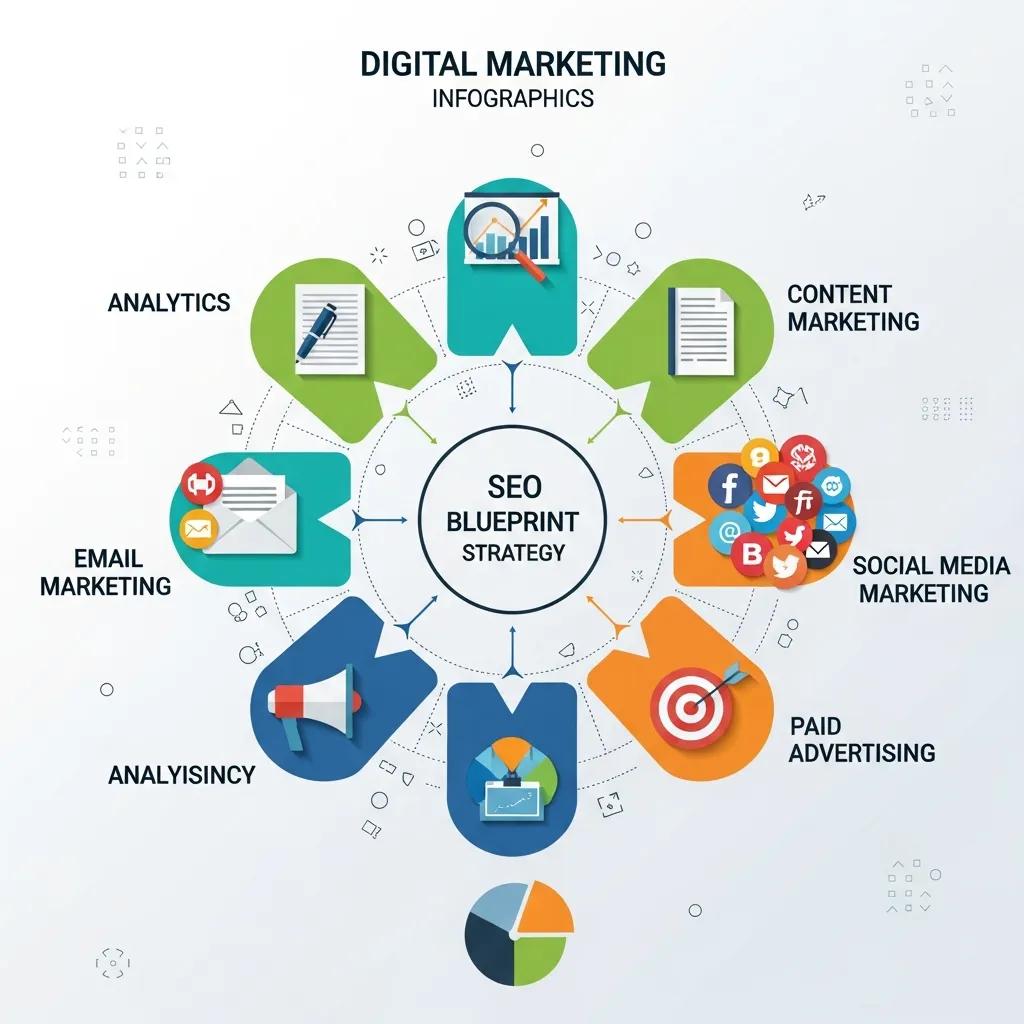
Digital Marketing Blueprint for Online Growth: A Complete, AI SEO-Driven Guide
A digital marketing blueprint is a structured roadmap that aligns goals, channels, content, and measurement to drive online growth for businesses and agencies. This guide explains what that blueprint looks like, how AI SEO and generative search change the rules, and how teams can operationalize a repeatable program that improves traffic, leads, and revenue. You will learn how to set SMART objectives, build audience personas, select a balanced channel mix, and apply entity-first keyword research, structured data, and AI-aware optimization to capture new visibility across search and LLM-driven answers. Along the way the guide outlines practical workflows, KPIs, and measurement cadences—plus where AI automation and platform support accelerate outcomes. Finally, the blueprint shows how operational tools scale agency work through automation, AI visibility tracking, and data-driven experimentation to sustain growth into 2026 and beyond.
What is the Digital Marketing Blueprint and why does it drive Online Growth?
The digital marketing blueprint is a strategic roadmap that connects business objectives to a coordinated set of digital activities so teams can convert visibility into measurable outcomes. It drives online growth by aligning goals, audience insights, channel tactics, and KPIs into a repeatable cycle of create → optimize → measure → iterate, which reduces wasted spend and improves incremental gains. The blueprint explicitly accounts for both traditional search signals and emerging AI-driven signals, enabling teams to capture organic traffic and LLM-sourced visibility simultaneously. When implemented well this roadmap turns content and technical investments into predictable increases in organic traffic, qualified leads, and scalable revenue.
Define the Digital Marketing Blueprint and its link to Online Growth
A digital marketing blueprint is composed of core components: defined business goals, mapped audience personas, prioritized channels, content plans, technical SEO foundations, and a testing-led measurement framework. Each component plays a causal role: goals determine KPIs, personas shape messaging, channels deliver reach, and measurement closes the loop so teams can reallocate resources to effective tactics. For example, entity-first keyword research plus structured data can increase relevant impressions that feed into higher-quality lead flow. Framing the blueprint as linked building blocks—Blueprint → enables → Online Growth—helps stakeholders trace specific investments to traffic, conversion, and revenue outcomes.
How AI SEO and Search Atlas fit into the blueprint
AI SEO augments traditional steps across research, creation, optimization, and measurement by surfacing new signals and automating repetitive tasks, while Search Atlas software and services act as an implementation layer that combines automation with visibility tracking. Search Atlas provides AI-powered Automation (automates metadata addition, title updating, internal linking) and Comprehensive SEO and AI Visibility by unifying traditional SEO tools with Generative Engine Optimization (GEO) capabilities. The platform tracks performance across Google, AI Overviews, ChatGPT, Perplexity, and other LLM-generated answers so teams see both classic organic metrics and new AI visibility signals. Integrating these capabilities into the blueprint reduces manual work, accelerates content optimization cycles, and helps agencies scale consistent performance for multiple clients.
How do you build a foundational strategy for online growth?
A foundational strategy begins with clear goals and a prioritized plan that maps outcomes to tactics and timelines. Build the strategy in three core steps: set measurable objectives, build data-backed audience personas, and run a focused competitor audit to identify opportunity gaps. This approach ensures your channel choices and content formats are informed by business priorities and actual market demand rather than guesswork. A well-defined foundation also allows teams to deploy iterative experiments and measure lift from both traditional SEO investments and AI-aware content changes.
How to define digital marketing goals and objectives
Start by converting business outcomes into SMART marketing objectives with target KPIs and timeframes, then map those objectives to channel-level metrics and conversion touchpoints. For example, a goal to increase qualified leads by 30% in six months translates into specific targets for organic sessions, conversion rate improvements, and content downloads. Define leading indicators (keyword rankings, AI Visibility Score) and lagging indicators (revenue per lead) so measurement captures early signals and long-term impact. Prioritize objectives using effort-versus-impact scoring and schedule quarterly reviews to reallocate resources based on performance.
How to develop audience personas and conduct competitor analysis
Create audience personas from first-party data, market research, and behavioral signals; include fields such as goals, pain points, favored content formats, and typical search intents. A lightweight competitor audit should cover keyword overlap, content gaps, backlink quality, and AI-derived visibility in LLM responses to identify where to win share. Use persona-driven content mapping to align top/mid/bottom-funnel assets with the channels your audience uses. Translate audit findings into a prioritized content backlog that balances quick wins (high-intent pages) with longer-term authority building.
Which core digital marketing channels matter for growth?
Several core channels work together to deliver acquisition, engagement, and retention: SEO for sustained organic growth, content marketing to drive and nurture leads, PPC for immediate demand capture, social for distribution and brand signals, and email for retention and conversion. Channel mix decisions depend on budget, audience behavior, and time horizon; long-term growth typically emphasizes SEO and content, while paid channels accelerate short-term results. Each channel contributes different data inputs to the blueprint, which collectively inform testing priorities and budgeting.
What is a comprehensive SEO strategy for online growth?

A comprehensive SEO strategy covers technical SEO, on-page optimization, off-page authority, entity-first keyword research, and structured data implementation to communicate context to search engines and LLMs. Technical foundations ensure crawlability and performance, while entity-first research prioritizes topical coverage that maps to knowledge graph concepts. Structured data helps search systems and generative models understand content intent and surface rich results; implement structured data and Schema.org markup (Article, HowTo, Product, Organization) where applicable to improve context signals. AI-assisted tooling can accelerate audits and schema generation so teams can scale consistent markup across content templates.
Different SEO pillars, their AI enhancements, and expected outcomes are summarized below to help prioritize effort.
This table shows how AI-enhanced workflows map to tangible SEO outcomes and where to focus early investments.
How does content marketing support lead generation?

Content marketing builds demand across the funnel with targeted formats that match intent: long-form guides and pillar pages for top-of-funnel discovery, case studies and product comparisons for mid-funnel evaluation, and conversion-focused landing pages and tools for bottom-funnel capture. Distribution amplifies reach—organic search, social channels, and partnerships—while gated assets and email nurture convert interest into leads. Measurement should connect content exposure to downstream conversions using UTM tagging, assisted-conversion reports, and content-level revenue attribution. Repeatable content playbooks and templates reduce production friction and enable faster iteration based on performance data.
How does AI-powered optimization with Search Atlas elevate the blueprint?
AI-powered optimization expands the blueprint by introducing new signals to measure, automations to execute routine tasks, and visibility tracking for generative channels. AI SEO and generative search change how discoverability is earned: models synthesize multiple sources, prefer clear entity signals, and surface concise answers, which creates opportunities for content that is structured, authoritative, and citation-rich. Search Atlas combines AI visibility insights with automation to help teams optimize content, monitor multi-source performance, and scale changes across portfolios without manual toil. As a result, agencies can increase throughput and capture visibility across both Google and LLM-driven results.
Search Atlas Feature mapping below shows core platform capabilities, what they automate or measure, and the practical benefit each provides to agencies and in-house teams.
Intro: The table maps Search Atlas capabilities to automation outcomes so readers can quickly scan how the platform supports blueprint tasks.
This mapping demonstrates how specific Search Atlas software and services translate into operational benefits and KPI impact for teams working at scale.
What is AI SEO and generative search in practice?
AI SEO refers to optimizing content and technical signals for both search engines and generative models so that content is discoverable, citable, and useful when LLMs synthesize answers. Generative search occurs when LLMs synthesize web content into concise responses and may rely on metrics such as citation frequency and share of model to decide which sources to surface. In practice, AI SEO combines entity-first content, clear structured data, and citation-friendly references so that content has both the context and trust signals LLMs favor. Tracking citation frequency and share of model becomes a practical way to measure whether content is being used in synthesized answers and whether that usage drives referral clicks.
How to automate on-page SEO and internal linking with OTTO?
OTTO supports a workflow that begins with site-wide detection of optimization opportunities, followed by suggested metadata addition and title updating, and then automated or semi-automated internal linking updates that preserve editorial control. A typical sequence: detect pages needing improved metadata -> OTTO generates suggestions and title updates -> OTTO recommends internal linking paths and can implement approved links -> monitor AI visibility impact and iterate. This approach reduces manual triage time and scales internal linking across large catalogs, which improves crawl paths and helps both search engines and generative models understand site relationships. Agencies benefit from faster deployment cycles and clearer measurement loops tied to visibility metrics.
– OTTO streamlines three core tasks for on-page SEO:
- Detect: Identify pages with missing or weak metadata and link opportunities.
- Suggest: Generate optimized titles, descriptions, and structured data proposals.
- Implement: Apply metadata addition, title updating, and internal linking at scale.
This concise workflow shows how automation magnifies human editorial capacity while preserving quality controls.
How do you measure, monitor, and adapt the blueprint for ongoing success?
Measurement for a modern blueprint combines classic organic metrics with AI-era visibility indicators to form a comprehensive scorecard that guides iteration. Use a monthly operational dashboard to track organic traffic, conversions, and authority metrics alongside AI Visibility Score and citation-based signals. Establish a cadence for audits and experiments—technical audits monthly, content experiments quarterly—and maintain a prioritized backlog of fixes that balance impact and effort. Data-driven adaptation ensures the blueprint stays responsive to algorithm and model changes and continuously improves ROI.
What KPIs should you track for AI and traditional SEO?
Combine traditional SEO KPIs with AI-specific metrics to capture the full picture of visibility and impact. Traditional indicators include organic sessions, landing page conversions, and backlink authority, while AI-era KPIs include AI Visibility Score, citation frequency, share of model, Featured Snippet Acquisition, and Knowledge Panel Impressions/Clicks. Define measurement methods for each KPI: use search analytics and on-site events for classic metrics, and use model-visibility tracking to quantify citations and share of model. Set sample targets and monitor trends rather than single data points to distinguish noise from meaningful changes.
- Classic SEO Metrics:Organic sessions and new users.Landing page conversion rate and goal completions.Backlink acquisition and referring domains.
- AI-specific Metrics:AI Visibility Score and trend over time.Citation frequency and share of model.Featured Snippet Acquisition and Knowledge Panel Impressions/Clicks.
After tracking these KPIs, teams can prioritize experiments that affect both click-driven and model-driven visibility.
How can data analytics inform continuous improvement?
Analytics pinpoints drop-offs, surfaces high-potential pages for optimization, and validates the impact of experiments so teams can invest in changes that move KPIs. Use a mixed toolset—Search Atlas for AI visibility and automation, Google Search Console for search appearance data, Google Analytics 4 for on-site behavior, and Semrush or Ahrefs for backlink and competitive insights—to triangulate causes and prioritize fixes. Adopt a regular audit cadence: technical audits monthly, content gap and performance reviews quarterly, and strategic planning semi-annually. Implement an experimentation framework with hypothesis, test, measurement, and learn phases so every change feeds back into the blueprint with measurable outcomes.
The importance of leveraging digital analytics for optimizing marketing performance is a well-established area of study.
Digital Analytics for Marketing Performance
The dissertation advances the knowledge in this area by investigating how industrial companies can use digital analytics for measuring and optimizing digital marketing performance. The use of digital analytics for measuring and optimizing digital marketing performance, J Järvinen, 2016
– Recommended audit and analytics workflow:
- Monthly: Technical crawl and performance checks.
- Quarterly: Content performance review and persona validation.
- Ongoing: Experimentation pipeline with measurement tied to KPIs.
The combined use of Search Atlas, Google Search Console, Google Analytics 4, Semrush, and Ahrefs enables teams to see both traditional organic performance and emergent AI visibility signals, making it possible to prioritize high-impact work confidently. For teams ready to scale, integrating AI-powered Automation and AI visibility tracking into the measurement loop shortens feedback cycles and improves allocation decisions while preserving editorial quality and strategic focus.