Top Cybersecurity Trends Every IT Leader Should Know in 2026
The cybersecurity landscape in 2026 is defined by accelerating offensive capabilities and equally rapid defensive innovation, and IT leaders must recalibrate strategy to manage shifting risk profiles. This article explains the most important trends—artificial intelligence, Zero Trust, quantum threats, ransomware resilience, and regulatory compliance—showing how each trend changes attacker behavior, detection requirements, and operational priorities. Readers will learn practical actions to shorten detection and response times, design crypto-agile architectures, harden backups and recovery, and automate compliance reporting to reduce breach risk. The guide synthesizes recent industry findings and standards so technical and executive stakeholders can translate trends into measurable programs. Each section includes concrete implementation steps, prioritized checklists, and examples of capabilities that align with modern cloud and database security models. Throughout, we reference relevant threat signals and standards so IT leaders can prioritize investments and governance workstreams for 2026 and beyond.
Key Takeaways
- AI-driven threat detection improves speed and accuracy, reducing false positives and enabling automated security operations.
- Agentic AI introduces complex autonomous attack vectors, requiring strong IAM, continuous monitoring, and AI governance controls.
- Zero Trust architecture enforces continuous verification, least privilege, and microsegmentation to reduce lateral movement risks.
- Quantum computing threatens current cryptography, necessitating crypto-agility and phased migration to post-quantum standards.
- Ransomware resilience depends on layered defenses, isolated backups, and tested recovery procedures to limit operational damage.
- Regulatory compliance mandates data discovery, encryption, and continuous auditing to meet GDPR, HIPAA, and industry requirements.
- Oracle security solutions support AI integration, Zero Trust enforcement, post-quantum cryptography, ransomware recovery, and compliance automation.
- Implementing cybersecurity trends requires phased, measurable programs aligned with evolving threat landscapes and regulatory frameworks.
How is AI Transforming Cybersecurity for IT Leaders in 2026?
AI-Driven Threat Detection and Automated Security Operations
AI-driven detection uses models to correlate signals across telemetry, identify anomalies, and prioritize alerts so analysts can focus on high-fidelity incidents. Compared to traditional detection, AI improves speed and reduces false positives by automating enrichment and contextualization, which shortens mean time to detect and mean time to respond. This shift supports Autonomous SOC workflows that integrate threat intelligence and orchestration tools to accelerate containment. Practical examples include integrating OCI Threat Intelligence Service for contextual threat data and Oracle Cloud Guard for automated policy-based actions while leveraging OCI IAM for identity-aware automation. Understanding these integrations helps teams move from alert-heavy operations to measurable outcomes.
This table compares traditional vs AI-enhanced detection across common attributes and shows where automation delivers the biggest operational gains.
This comparison demonstrates why AI-enhanced detection is becoming a core investment for SOC modernization and sets up the need to address new AI-driven attack vectors.
Agentic AI Threat Vectors and Defensive Measures
Agentic AI refers to systems that can autonomously plan and execute multi-step actions, enabling adversaries to scale sophisticated campaigns like automated phishing, exploitation, and deepfake-enabled social engineering. Evidence of this trend includes a surge in automated phishing effectiveness and broader AI-enabled offensive activity: Phishing attacks surged by 1,265 percent year-on-year (SentinelOne 2025 report), and there was an 89 percent increase in attacks from AI-enabled adversaries (CrowdStrike 2025). Microsoft Threat Intelligence detected approximately 830 million email-based phishing threats in Q1 2026, with QR code phishing emerging as a fast-growing attack vector. Defenses should combine strong IAM, continuous monitoring, AI governance, and layered detection controls.
Further research highlights the inherent architectural complexity and autonomous decision-making capabilities of agentic AI systems, which introduce novel and poorly understood security risks.
Security Risks and Trustworthiness Assessment of Agentic AI Systems
Agentic artificial intelligence (AI) systems are anticipated to have transformative impacts across various sectors, including critical domains such as finance and healthcare. Their inherent architectural complexity, autonomous decision-making capabilities, adaptive behaviors, and capacity for tool interaction with the environment are also likely to introduce novel and poorly understood security risks. Current security research and risk management frameworks remain in nascent stages of development and are thus insufficient for adequately addressing the complex vulnerabilities unique to agentic AI. From threat to trust: assessing security risks of agentic AI systems: M. Leo et al., 2026
To counter agentic AI, adopt continuous verification in identity controls, threat-intelligence feeds for contextual blocking, and playbook automation that ties detection to containment. These steps naturally lead into designing identity-first architectures such as Zero Trust to limit automated lateral movement.
- Key defensive controls to prioritize: Strong IAM enforcement : Enforce least privilege and continuous authentication across sessions. Continuous monitoring : Centralize telemetry and use AI for anomaly detection. AI governance : Define safe model deployment, auditability, and human-in-the-loop checkpoints.
How to Implement Zero Trust Architecture in Large Enterprises
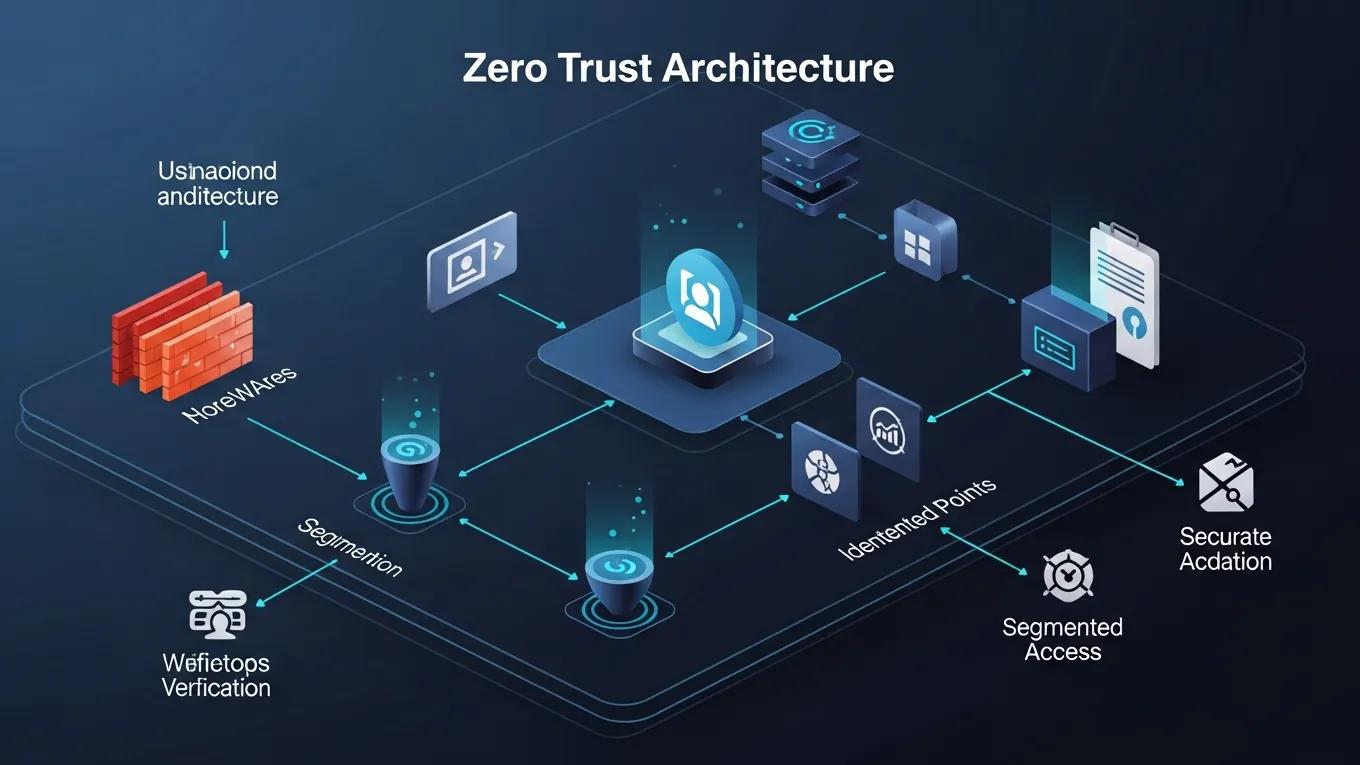
Zero Trust is a security model that assumes no implicit trust and enforces continuous verification, least privilege, and microsegmentation across resources; it derives guidance from NIST SP 800-207. The model works by shifting trust checks to every access decision and by using telemetry and policy enforcement as continuous controls, producing measurable reductions in lateral movement and credential abuse. For large enterprises, Zero Trust requires phased adoption—identity-first policies, segmentation, and consistent telemetry—to make policy enforcement auditable and scalable. Leaders should treat Zero Trust as an engineering and organizational program that maps clearly to telemetry, enforcement tooling, and maturity metrics.
A proposed methodology for implementing Zero Trust Architecture, aligned with NIST guidelines, emphasizes a certainty-based approach to enhance access control and policy enforcement.
Implementing Zero Trust Architecture with Certainty-Based Methodology
This paper proposes a certainty-based methodology for implementing the Zero Trust Architecture (ZTA) as defined in NIST SP 800-207 and NIST SP 1800-35 (NIST, 2020; NIST, 2025). By applying a probabilistic model that quantifies the certainty of security-related facts, the proposed approach enhances decision-making for access control and security policy enforcement. This method utilizes major security databases to assess and compute certainty of facts, thereby improving the resilience, adaptability, and accuracy of Zero Trust systems (Liu, Chandramouli, & Kuhn, 2020). A Certainty-Based Approach to Implementing Zero Trust Architecture Using NIST SP 800-207 and NIST SP 1800-35, YB Choi, 2020
Core Zero Trust Principles and Components
NIST SP 800-207 codifies Zero Trust principles focused on continuous authentication, least privilege, and dynamic policy enforcement; these principles guide microsegmentation, service-level policies, and telemetry requirements. Implementation checklist items include inventorying identity and access flows, mapping attack surfaces for segmentation, and instrumenting telemetry for policy evaluation. Measurement should track authentication success rates, policy decision latency, and segmentation effectiveness to evaluate maturity. Start with three first actions: identify high-value assets, enforce identity-based access, and pilot microsegmentation to validate telemetry and policy enforcement.
- Inventory critical assets : Map data flows and identity relationships for high-priority systems.
- Enforce identity-first access : Apply continuous authentication and least-privilege policies.
- Pilot segmentation : Isolate key workloads and verify policy decision telemetry.
This sequence of practical steps leads directly into product and integration patterns that support enforcement at the network and identity layer.
Oracle Zero Trust Solutions: Packet Routing Platform and IAM Integration
Oracle Zero Trust Packet Routing Platform provides a network-enforcement approach that fits into Zero Trust deployments by isolating flows and enabling fine-grained policy enforcement at packet level. When combined with OCI Identity and Access Management, policy decisions can be tied to identity context and telemetry, enabling automated enforcement across cloud-hosted workloads. High-level integration patterns include using identity signals to drive routing and access policies, and leveraging packet-level controls to prevent unauthorized data egress or lateral movement. These product capabilities exemplify how identity and network enforcement work together without prescribing exact deployment scripts.
Deployment considerations for large networks:
- Deployment considerations for large networks: Map identity to network policies : Use OCI Identity and Access Management to inform routing rules. Enforce at packet boundaries : Apply packet routing policies where segmentation is required. Measure effectiveness : Track policy hits and denied flows to refine enforcement.
These integration steps make Zero Trust actionable and measurable in enterprise environments, preparing teams for the cryptographic and resilience challenges ahead.
What You Need to Know About Quantum Computing and Post-Quantum Cryptography

Quantum computing threatens certain cryptographic primitives by enabling algorithms that can break widely used asymmetric key schemes; Gartner predicts advances in quantum computing will render asymmetric cryptography unsafe by 2030. The mechanism is straightforward: sufficiently powerful quantum hardware can run algorithms that undermine RSA and ECC, so IT leaders must pursue crypto-agility and phased migration strategies that align with standards like NIST Post-Quantum Cryptography Standardization. The immediate benefit of planning now is reduced technical debt and the ability to pilot hybrid solutions that protect long-lived data and critical authentication systems.
Specifically, quantum algorithms like Shor’s are capable of factoring integers and solving discrete logarithm problems in polynomial time, necessitating the replacement of widely deployed public key cryptosystems.
Post-Quantum Cryptography: Replacing Vulnerable Systems
Using quantum computers, an integer *n* can be factored in polynomial time using Shor’s algorithm. The discrete logarithm problem can also be solved by Shor’s algorithm in polynomial time. As a result, the public key cryptosystems deployed since the 1980s will need to be replaced, including: RSA signatures, DSA, and ECDSA (FIPS 186-4); Diffie-Hellman Key Agreement over finite fields and elliptic curves (NIST SP 800-56A); and RSA encryption (NIST SP 800-56B).
NIST post-quantum cryptography standardization, D Moody, 2017
Quantum Threat Landscape and Crypto-Agility
Assess which assets rely on at-risk algorithms and prioritize those with long-term confidentiality needs; typical at-risk algorithms include common asymmetric schemes used in TLS, code signing, and key exchange. Crypto-agility means the ability to swap or augment algorithms without massive system rewrites, and first practical steps are inventory, hybrid cryptography pilots, and key-management modernization. Standards tracking is essential; follow NIST Post-Quantum Cryptography Standardization milestones to time production rollouts. These measures reduce exposure for data that must remain confidential beyond the 2030 horizon.
- Inventory cryptographic assets : Identify where asymmetric keys protect long-lived data.
- Pilot hybrid algorithms : Combine classical and post-quantum primitives where supported.
- Modernize key management : Ensure key rotation and lifecycle controls are automated.
Inventorying and piloting naturally lead to vendor and platform evaluations that support migration without disrupting core services.
Post-Quantum Cryptography Roadmaps and Oracle’s Crypto-Strategy
A pragmatic roadmap follows assess → inventory → pilot hybrid PQC → plan migration, aligning with standards from NIST Post-Quantum Cryptography Standardization. Oracle Advanced Security and key-management capabilities are examples of platform features that can enable crypto-agility by centralizing encryption controls and certificate lifecycle management for databases and applications. Enterprise recommendations include piloting hybrid schemes for high-value channels and preparing certificate and key-rotation plans to minimize service interruptions. Framing this work as “crypto-hygiene” helps prioritize funding and cross-functional engagement.
How to Achieve Ransomware Resilience: Data Protection and Recovery
Ransomware resilience depends on preventing initial access, detecting and containing activity quickly, and ensuring robust, tested recovery procedures; recent data shows extortion figures increased by 63 percent from last year due to supply chain attacks (Intel 471, 2026 outlook), making resilience a financial imperative. Attack trends show that Initial Infection Vectors: Exploits remained the most common initial infection vector for the sixth consecutive year, accounting for 32 percent of intrusions in 2025 (Google Cloud M-Trends 2026), while phishing volumes remain elevated. Resilience blends layered defenses—EDR/MDR, network segmentation, threat intelligence—and disciplined backup and recovery practices to limit operational damage.
Ransomware Attack Vectors and Defense Strategies
Prioritize defenses against the most common vectors: exploits, phishing, and supply-chain compromise. Use EDR and continuous monitoring to detect behavior indicative of ransomware, segment backups from production networks, and apply strict access policies for privileged accounts. Threat intelligence integration speeds detection and aids in blocking known indicators. Regular tabletop exercises and restore drills validate that people and processes can recover within RTO/RPO targets and reduce the leverage attackers gain from encrypted backups.
- Prioritized mitigation checklist: Harden exploit surfaces : Patch management and vulnerability scanning. Defend against phishing : Email filtering combined with user training and threat intel. Isolate backups : Immutable and air-gapped backups with tested restores.
These operational practices connect directly to recovery architecture choices and platform support options.
Backup, Recovery, and Data Resilience with Oracle Solutions
Backup and recovery architectures should aim for immutable backups, clear restore SLAs, and regular testing; backup and recovery as resilience strategies are central to limiting ransomware impact. Oracle Database Security Solutions and Oracle Data Safe provide database-focused controls that simplify inventory and control of sensitive data, while Oracle Advanced Security and Oracle Database Vault help protect data in use and limit privileged misuse. Oracle Audit Vault and Database Firewall add auditing and policy enforcement to reduce attack surfaces, and Oracle Managed Security Services can supplement operational capacity for monitoring and incident response. These capabilities can be combined to meet RTO/RPO targets and validate restore procedures.
Navigating Cybersecurity Regulatory Compliance in 2026
Regulatory compliance remains a baseline obligation for many organizations, with GDPR and HIPAA among primary frameworks that define data protection obligations and reporting requirements. Compliance works by codifying data handling, retention, breach notification, and access controls, which in turn shape technical controls such as encryption, audit logging, and data minimization. Automation and continuous auditing reduce the manual burden of evidence collection and reporting, enabling IT teams to respond faster to regulator inquiries and breach events.
GDPR, HIPAA, and Industry-Specific Regulations
GDPR and HIPAA impose distinct obligations—GDPR emphasizes personal data rights and breach notification across jurisdictions, while HIPAA defines safeguards for protected health information—so IT leaders must map controls to specific obligations and prioritize remediations by impact. Sector-specific regulations add reporting cadence and technical controls, making a prioritized compliance checklist essential. Focus first on discovery, access controls, and logging to build defensible evidence for audits and incident responses.
- Data discovery and classification : Identify regulated assets for control mapping.
- Access and encryption controls : Apply least privilege and strong encryption.
- Logging and retention policies : Ensure audit trails meet retention requirements.
Compliance Automation, Auditing & Reporting with Oracle
Automation can accelerate compliance tasks such as data discovery, masking, and continuous auditing; Oracle Data Safe offers discovery and assessment capabilities that help identify and protect sensitive data, and Oracle Audit Vault and Database Firewall provide auditing and enforcement that support regulatory evidence collection. Mapping these capabilities to compliance controls reduces the time required for manual evidence collection and helps integrate compliance reporting into SOC processes. Use cases for compliance automation:
- Automated data discovery : Rapidly locate regulated datasets for remediation.
- Continuous auditing : Maintain persistent evidence for audits and investigations.
- Policy enforcement : Block or log non-compliant database activity.
These automation patterns reduce compliance risk and free teams to focus on higher-value security engineering work.
Frequently Asked Questions
What is the significance of Zero Trust in modern cybersecurity?
Zero Trust is a security model that operates on the principle of “never trust, always verify.” It emphasizes continuous verification of user identities and device security, regardless of their location within or outside the network. This approach helps mitigate risks associated with insider threats and lateral movement by enforcing strict access controls and microsegmentation. As cyber threats evolve, adopting Zero Trust architecture is crucial for organizations to enhance their security posture and protect sensitive data effectively.
How can organizations prepare for quantum computing threats?
Organizations can prepare for quantum computing threats by adopting a strategy known as crypto-agility. This involves assessing current cryptographic assets, identifying those at risk from quantum attacks, and planning for the transition to post-quantum cryptography. Steps include inventorying cryptographic keys, piloting hybrid cryptographic solutions, and modernizing key management practices. By proactively addressing these vulnerabilities, organizations can safeguard their data against future quantum threats and ensure long-term confidentiality.
What are the best practices for ransomware resilience?
To achieve ransomware resilience, organizations should implement a multi-layered defense strategy that includes robust backup and recovery procedures, continuous monitoring, and threat intelligence integration. Key practices involve isolating backups from production networks, conducting regular restore drills, and applying strict access controls for privileged accounts. Additionally, organizations should prioritize employee training to recognize phishing attempts and other common attack vectors, thereby reducing the likelihood of successful ransomware attacks.
How does AI enhance cybersecurity operations?
AI enhances cybersecurity operations by automating threat detection and response processes, significantly improving the speed and accuracy of identifying potential threats. AI-driven systems analyze vast amounts of data to detect anomalies and prioritize alerts, allowing security teams to focus on high-risk incidents. This automation reduces false positives and shortens the mean time to detect and respond to threats, ultimately leading to more efficient security operations and a stronger defense against cyber attacks.
What role does regulatory compliance play in cybersecurity?
Regulatory compliance is essential in cybersecurity as it establishes a framework for data protection and risk management. Compliance with regulations like GDPR and HIPAA ensures that organizations implement necessary safeguards for sensitive data, including encryption, access controls, and breach notification procedures. By adhering to these regulations, organizations not only mitigate legal risks but also enhance their overall security posture, fostering trust with customers and stakeholders while ensuring accountability in data handling practices.
What are the emerging trends in cybersecurity for 2026?
Emerging trends in cybersecurity for 2026 include the increasing adoption of AI for threat detection, the implementation of Zero Trust architectures, and the growing importance of quantum-resistant cryptography. Additionally, organizations are focusing on ransomware resilience and regulatory compliance as critical components of their security strategies. As cyber threats evolve, staying informed about these trends will help IT leaders adapt their strategies and invest in technologies that enhance their security posture and protect against future risks.
Conclusion
Understanding the top cybersecurity trends for 2026 equips IT leaders with the insights needed to navigate evolving threats and regulatory landscapes. By embracing AI-driven detection, Zero Trust architectures, and proactive ransomware resilience strategies, organizations can significantly enhance their security posture. Implementing these measures not only mitigates risks but also ensures compliance with emerging regulations, fostering trust and reliability. Take the next step in fortifying your cybersecurity strategy by exploring our comprehensive resources and solutions today.