How to Choose the Right Cloud Provider in 2026: An Oracle Enterprise Guide
The cloud market in 2026 demands decisions grounded in cost, security, and operational risk: the global cloud computing market is valued at approximately $947.3 billion in 2026 and is projected to surpass $1 trillion by 2027, while public cloud now represents roughly 46 percent of enterprise IT spending. This guide gives enterprise architects and procurement teams a structured decision framework to evaluate providers, map workloads to platform capabilities, and balance price-performance against compliance and resilience. You will learn the core selection criteria, a comparative framework for major providers, how hybrid and multi-cloud patterns alter vendor choice, and a practical checklist for procurement and technical teams. The article integrates current market context—market shares (AWS 31-32 percent, Microsoft Azure 23-27 percent, Google Cloud Platform (GCP) 11-13 percent as of Q1 2026) and adoption trends (92 percent of organizations run a multi-cloud strategy; 73 percent operate hybrid cloud estates)—so you can apply criteria against realistic industry baselines. Finally, the guide includes concrete evaluation tools (tables and checklists) and a limited set of factual vendor examples to illustrate hybrid and workload-specific choices.
Key Takeaways
- Choosing the right cloud provider in 2026 requires evaluating price-performance, security, compliance, and hybrid cloud capabilities.
- Price-performance should be measured by total cost of ownership per workload and real utilization benchmarks.
- Security assessments must include encryption, isolation models, certifications, and enterprise-grade compliance evidence.
- Hybrid and multi-cloud strategies are critical due to widespread adoption and influence on latency, governance, and migration.
- Oracle Cloud Infrastructure (OCI) offers strong hybrid options, enterprise security, and competitive price-performance for regulated workloads.
- Cost modeling should incorporate compute, storage, egress, licensing, and FinOps governance for transparent cloud spending.
- Performance benchmarks must reflect workload-specific metrics like latency, throughput, and scalability under realistic conditions.
- A practical evaluation checklist includes workload matching, cost transparency, security posture, SLA review, and exit planning.
- Effective cloud provider selection balances technical, operational, and contractual factors to support long-term enterprise goals.
What criteria should guide cloud provider selection in 2026?
Selecting a cloud provider in 2026 requires clear criteria that translate strategic priorities into measurable evaluation metrics. Core axes include price-performance, security, data residency and compliance, hybrid/multi-cloud flexibility, and SLA commitments; each criterion should map to procurement questions and technical tests to differentiate providers. Decision teams should quantify these criteria using workload-level metrics—TCO per workload, latency budgets, compliance attestations, and SLA financials—so comparisons become objective rather than rhetorical. The following list defines the essential criteria and what to measure for each so stakeholders can quickly shortlist providers by measurable thresholds.
- Price-performance: Measure TCO per workload and effective compute/storage cost under expected utilization rates.
- Security and compliance: Verify isolation models, encryption at rest/in transit, and audit evidence for required certifications.
- Data residency and governance: Confirm regional data controls, cross-border transfer policies, and evidence of residency guarantees.
- Hybrid and multi-cloud capabilities: Assess interconnect options, managed on-prem offerings, and orchestration across clouds.
- SLAs and support: Review financially backed SLAs, incident response commitments, and escalation processes.
- Ecosystem and AI/ML services: Evaluate available AI infrastructure, managed services, and integration with existing vendor tools.
- Sustainability and operational transparency: Request energy and efficiency metrics where relevant.
These criteria form the shortlist that converts strategy into procurement experiments and benchmarks. With clear thresholds defined, teams can design RFPs, run pilots, and collect comparable telemetry that feeds into a vendor scorecard.
Price-performance, security, and data residency as core axes
Price-performance denotes the delivered workload throughput and latency relative to total cost; measure it by benchmarking representative workloads with real utilization patterns and by modeling egress and storage behavior. Security is the second decisive axis: confirm provider isolation primitives, encryption standards, vulnerability management, and the availability of hardware or off-box security options when the workload demands it. Data residency maps to legal and regulatory constraints—capture which regions a provider can guarantee residency in and what controls exist for cross-border flows. Together, these three axes let teams decide whether a provider meets both technical SLAs and regulatory guardrails. Establishing measurable acceptance criteria for each axis enables rapid disqualification of providers that cannot meet minimum thresholds.
Hybrid and multi-cloud capabilities and ecosystem integration
Hybrid and multi-cloud capabilities determine whether a provider fits into a larger, heterogeneous estate, influencing migration complexity and long-term flexibility. Evaluate direct interconnect latency, existence of managed on-prem appliances, support for dedicated regions, and compatibility of management and security tooling across clouds. Integration also includes third-party ecosystem compatibility—how the provider supports identity federation, observability toolchains, and data pipelines with other platforms. Operationally, require proof-of-concept tests for cross-cloud data movement and unified management to validate claims. Strong hybrid/multi-cloud capabilities reduce vendor lock-in risk and simplify governance across distributed estates.
How does OCI compare with AWS, Azure, and GCP on critical enterprise dimensions?
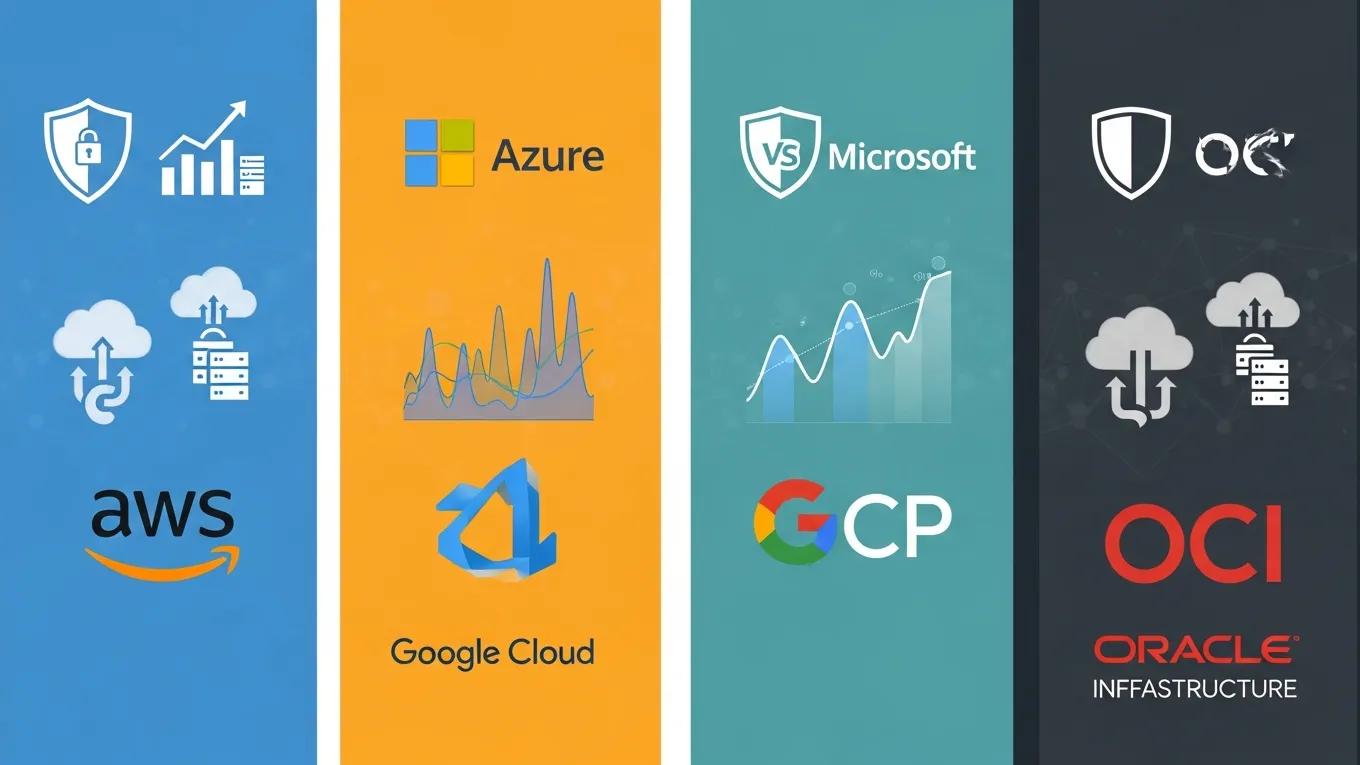
Comparing providers requires mapping the same dimensions across vendors and reading commitments in service descriptions and SLAs rather than marketing language. Key dimensions to compare are price-performance, security and compliance posture, hybrid capability, SLA strength, and AI/ML service fit; evaluate each provider by the same workload tests and SLA scenarios. The table below provides a focused comparison across those dimensions so technical and procurement teams can scan strengths and limitations quickly.
The following table summarizes provider attributes for quick scanning:
This side-by-side view clarifies where providers emphasize different strengths and where workload-level benchmarking is essential. When interpreting these attributes, pair vendor claims with test results, third-party benchmarks, and procurement-validated SLAs.
After summarizing neutral comparisons, note the following vendor-specific UVPs drawn from available enterprise positioning: Oracle Cloud Infrastructure (OCI) claims “Superior Price-Performance“, “Enterprise-Grade Security“, “Hybrid and Multi-cloud Capabilities“, “High Performance and Scalability”, “Support for Oracle Workloads”, and “Comprehensive SLAs“. Use these statements as factual, vendor-stated value propositions to inform but not dictate your evaluation framework.
Price-performance and licensing framework in real-world workloads
Price-performance comparisons must be workload-specific and account for licensing implications, egress patterns, and instance type fit; begin by defining representative workloads (e.g., OLTP database, batch analytics, AI training) and measuring throughput and latency under realistic load. Licensing can materially change TCO when vendor-supplied images or bring-your-own-license models apply; include software license costs, support premiums, and migration re-licensing in models. Practical benchmarking includes running a canonical transaction or training job across providers and capturing cost per unit of work, then normalizing for sustained and peak scaling. Third-party benchmarks and independent validation help corroborate internal tests and reduce the risk of vendor-optimized scenarios.
Modeling should fold in realistic scaling patterns and FinOps governance so teams can revisit assumptions as usage evolves. Effective RFPs request modeled scenarios from vendors to validate pricing transparency.
Enterprise-grade security, compliance, and Service-Level Agreements
Enterprise security evaluation should verify architectural controls—network isolation, identity and access management integration, consistent patching, and available hardware security modules or isolation technologies. Compliance assessment requires obtaining evidence: certifications, attestations, and third-party audits that cover the specific regimes your workloads must follow. SLAs must be read as contracts: identify availability, manageability, and performance SLAs and the exact financial remedies or credits offered; financially backed SLAs reduce residual vendor risk for mission-critical services. Procurement should align acceptable risk thresholds for each workload with the provider’s documented SLA language and require visibility into operational metrics to validate SLA performance.
Why do hybrid and multi-cloud strategies influence provider selection in 2026?
Hybrid and multi-cloud strategies influence selection because most enterprises now run distributed estates where latency, regulation, and legacy workloads all matter; 92 percent of organizations run a multi-cloud strategy and 73 percent operate hybrid cloud estates, so vendor choice must accommodate this reality. Business drivers include regulatory data residency, latency-sensitive workloads, and staged migration of legacy applications that cannot immediately move to public cloud. Technical evaluation of providers must measure interconnect latency, on-prem appliance options, and orchestration compatibility to ensure a cohesive hybrid architecture. Given these factors, providers with robust hybrid offerings reduce migration friction and operational complexity for enterprises.
The complexities and strategic importance of these distributed environments are further elaborated in academic surveys on hybrid and multi-cloud integration.
Hybrid and Multi-Cloud Strategies: Challenges, Security, and Resilience
The rapid evolution of cloud computing has led organizations to adopt hybrid and multi-cloud environments to meet increasing demands for scalability, flexibility, and resilience. While these environments provide significant benefits, they present distinct challenges, including interoperability, data consistency, security, and vendor lock-in. This survey provides a comprehensive review of deployment architectures, integration strategies, middleware roles, and the challenges associated with multi-vendor cloud systems. The survey’s findings indicate that middleware plays a critical role in enabling seamless communication, abstraction, orchestration, and maintainability across heterogeneous cloud platforms. A Survey on Hybrid and Multi-Cloud Environments: Integration Strategies, Challenges, and
Future Directions, JV Mamidala, 2023
OCI’s hybrid/multi-cloud assets: Dedicated Regions, Exadata Cloud@Customer, and interoperability
Concrete hybrid offerings provide distinct operational choices: Dedicated Regions and on-prem equivalents let organizations run managed cloud stacks within a specific geography, while appliances such as Exadata Cloud@Customer move optimized database infrastructure into a customer-controlled environment. Interconnect options enable lower-latency communication between public cloud and on-prem systems, while interoperability efforts simplify cross-cloud data flows. As examples, Oracle supports Dedicated Regions and Exadata Cloud@Customer as on-prem or quasi-on-prem options and offers Oracle-Microsoft Azure Interconnect for tighter interoperability between clouds. These types of assets are especially useful when latency, data residency, or regulatory constraints prevent fully public deployments.
Further insights into the practical application of hybrid cloud strategies, particularly concerning regulated workloads and Oracle Exadata migrations, are explored in recent research.
Oracle Exadata Migration: Hybrid Cloud, Security and Compliance Framework
Financial institutions face increasing pressure to modernize their legacy data warehouses to meet contemporary demands for speed, scalability, and compliance. Traditional on-premises systems often incur high maintenance costs, suffer from inefficient data pipelines, and present performance limitations that hinder the execution of real-time analytics and compliance reporting. This article presents a pragmatic approach to migrating legacy data warehouses to Oracle Exadata within regulated financial environments. The framework emphasizes the critical balance between modernization and stringent security and compliance regulations, such as PCI-DSS, GDPR, and SOX. It outlines a step-by-step methodology that encompasses readiness assessment, data profiling, architectural refinement, and incremental migration methods. These steps are underpinned by automated testing and data validation.
Modernizing Legacy Data Warehouses: A Framework for Exadata Migration in Regulated Financial Ecosystems, G Nookala, 2025
Data residency and cross-cloud governance
Data residency requires explicit validation of where data is stored, who can access it, and how transfers are controlled; evaluate provider controls for regional isolation, key management, and documented cross-border transfer processes. Governance patterns should include central policy enforcement (access controls, encryption policies), unified logging and audit trails, and regular compliance audits to produce evidence for regulators. Tools that enable attribute-based access controls and automated policy checks across clouds reduce human error and ensure consistent enforcement. Effective cross-cloud governance combines technical controls with operational processes for auditability and incident response.
How should cost, performance, and risk be assessed using a provider comparison framework?
An actionable provider comparison framework breaks down cost, performance, and risk into measurable components, ties each to workload requirements, and prescribes tests and data sources to populate a decision model. Cost assessment follows FinOps principles—track real usage, attribute costs to teams, and build scenarios that include hidden vectors such as egress and licensing. Performance assessment requires standardized benchmarks and real workload tests that mirror production patterns. Risk assessment covers SLA review, support models, exit and data egress plans, and the provider’s historical reliability. Together, these assessments form a repeatable supplier evaluation process that supports objective vendor selection.
Empirical studies provide valuable insights into the quantitative benchmarking of cloud versus on-premises solutions, particularly concerning cost-performance metrics for critical enterprise applications like ERP.
Cloud vs. On-Premises ERP: Cost-Performance Benchmarking and Associated Risks
This study addresses the critical issue that organizations often select between cloud and on-premises ERP analytics solutions without robust, workload-normalized empirical data, which substantially elevates both cost and performance risks. The primary objective was to benchmark various ERP analytics architectures and investigate the relationship between architecture type and analytics effectiveness. Employing a quantitative, cross-sectional, case-based research design, objective cost and performance indicators were meticulously collected over a fixed four-week period. These indicators were then correlated with data from a 5-point Likert scale survey administered to participants from both cloud-based and on-premises ERP implementations (n = 152 valid responses, comprising n = 79 from cloud deployments and n = 73 from on-premises deployments). Key variables examined included architecture type (coded as cloud = 1), total monthly analytics-related cost, cost per active user, latency (measured by median and 95th percentile), throughput under 50-user concurrency, system availability, incident rate, and recovery time.
Quantitative Benchmarking of ERP Analytics Architectures: Evaluating Cloud vs On-Premises ERP Using Cost-Performance Metrics, BMT Haque, 2020
Cost modeling, price transparency, and FinOps practices
Effective cost models list all line items—compute, storage, network egress, special hardware, and licensing—and map them to expected consumption patterns and growth trajectories. Hidden costs such as migration data transfer, specialized support, and long-term storage tiers must be included. FinOps practices formalize ownership of cost accountability, enforce tagging for chargeback, and schedule regular reviews of procurement and usage. RFPs should request scenario-based pricing from vendors and include clauses for price transparency and periodic reconciliation. Teams should also define thresholds that trigger re-negotiation or migration planning.
- Key cost drivers include compute, storage, egress, and licensing charges that vary by workload.
- Ask vendors for modeled scenarios and include sustained-use discounts explicitly in comparisons.
- Adopt FinOps roles and weekly governance cycles to keep cost assumptions aligned with actual usage.
Sustained cost governance ensures vendor choices remain optimal as usage patterns evolve.
Performance benchmarks, scalability, and reliability metrics
Performance benchmarks should be chosen to reflect critical workload behavior—database p99 latency under mixed read/write, data pipeline throughput for analytics, and throughput/time-to-train for AI workloads—and must be repeatable across providers. Scalability validation includes both vertical scaling (larger instances) and horizontal scaling (elasticity), with attention to how quickly capacity can be provisioned under load. Reliability metrics include SLA uptime, recovery time objectives (RTO), and mean time to recovery (MTTR); ensure that these metrics are verifiable through provider telemetry or third-party monitoring. Translate benchmark outcomes into procurement criteria by setting minimum acceptable performance thresholds and remediation paths for failures.
What is a practical cloud provider evaluation checklist for 2026?
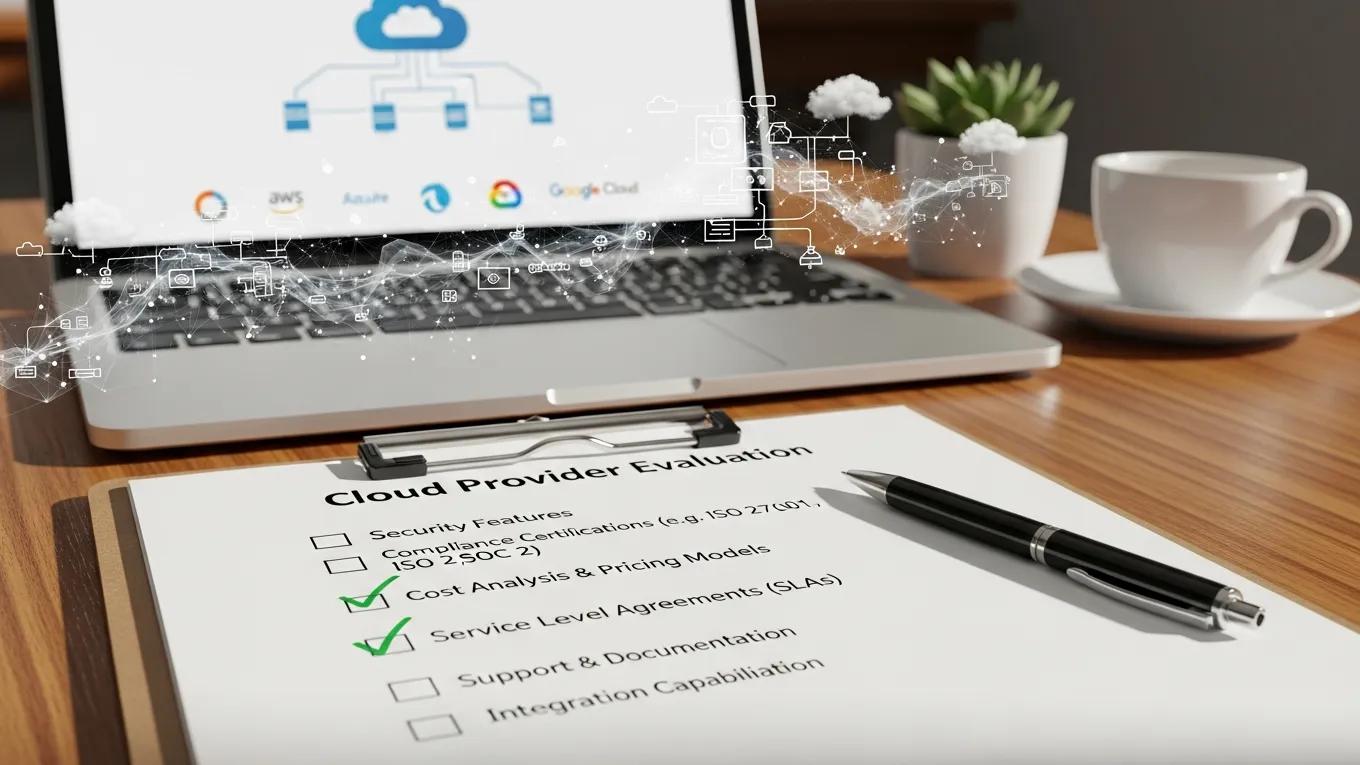
A concise checklist helps technical and procurement teams move from principles to actions during vendor selection. Items should be testable, assigned to owners, and scheduled within procurement timelines so that each vendor can be evaluated against identical criteria. The following checklist combines technical, contractual, and operational validation steps that convert the framework above into concrete selection activities.
Use this checklist to enforce parity across vendors and to document objective pass/fail decisions during shortlisting.
Pre-selection criteria and workload matching
Pre-selection filters reduce the candidate pool quickly by excluding providers that cannot meet minimum workload requirements for performance, compliance, or geography. Classify workloads into templates—OLTP database, data analytics, AI training, and web front-end—and map each to minimum compute, storage, and latency budgets to qualify providers. Require providers to run short pilot tests for representative workloads and deliver quantitative results within an agreed timeframe. Tools such as standardized benchmark suites and network latency monitors help create apples-to-apples comparisons during pre-selection.
- Define workload templates and minimum technical thresholds for each.
- Require pilot runs and measured results for shortlisted vendors.
- Use standardized metrics and tagging to ensure comparable telemetry across pilots.
These pre-selection steps reduce procurement time and surface the providers that can realistically support your estate.
Migration planning, security readiness, and SLA expectations
A phased migration plan mitigates risk: start with a pilot, proceed to lift-and-shift for non-critical workloads, and then optimize for cloud-native efficiencies. Security readiness requires validating controls before cutover—identity federation, encryption key management, logging pipelines, and incident response playbooks must be in place. SLA expectations should be codified in contracts with clear measurement points, financial remedies, and regular reporting cadence. Articulate exit criteria and runbook steps so that migration can be reversed or altered if performance or cost targets are not met.
- Plan a three-phase migration: pilot, migration wave(s), optimization.
- Validate security controls with pre-cutover audits and live incident drills.
- Negotiate SLA clauses with measurable metrics and defined financial remedies.
When relevant, brief vendor-specific capabilities that address checklist items. For example, Oracle Cloud Infrastructure (OCI) provides on-prem-equivalent options such as Exadata Cloud@Customer and Dedicated Regions that can simplify migrations for latency-sensitive and regulated workloads; interoperability solutions like Oracle-Microsoft Azure Interconnect can reduce cross-cloud friction for hybrid scenarios. These factual vendor offerings serve as illustrative options when matching workload constraints to provider capabilities.
Frequently Asked Questions
What are the key benefits of adopting a multi-cloud strategy?
Adopting a multi-cloud strategy allows organizations to leverage the strengths of different cloud providers, enhancing flexibility and resilience. It helps avoid vendor lock-in, enabling businesses to choose the best services for specific workloads. Additionally, multi-cloud strategies can improve performance by allowing data and applications to reside closer to users, reducing latency. Organizations can also enhance their disaster recovery capabilities by distributing workloads across multiple clouds, ensuring that if one provider experiences an outage, others can maintain operations.
How can organizations ensure compliance with data residency regulations in the cloud?
To ensure compliance with data residency regulations, organizations should carefully evaluate cloud providers’ data storage locations and their policies on data transfer. It’s essential to choose providers that offer clear documentation on where data is stored and how it is managed. Implementing strong governance practices, such as regular audits and compliance checks, can help maintain adherence to regulations. Additionally, organizations should utilize tools that enforce access controls and encryption policies to safeguard sensitive data across different jurisdictions.
What role does cost transparency play in cloud provider selection?
Cost transparency is crucial in cloud provider selection as it helps organizations avoid unexpected expenses and manage their budgets effectively. Providers should offer clear pricing models that outline all potential costs, including compute, storage, and data transfer fees. By requesting scenario-based pricing and conducting thorough cost analyses, organizations can better understand the total cost of ownership (TCO) for their cloud solutions. This transparency enables informed decision-making and helps align cloud spending with business objectives.
How can organizations assess the security posture of a cloud provider?
Assessing a cloud provider‘s security posture involves reviewing their security architecture, compliance certifications, and incident response capabilities. Organizations should request detailed documentation on security measures, such as encryption standards, identity and access management, and vulnerability management practices. Conducting third-party audits and penetration tests can provide additional assurance of the provider’s security effectiveness. Furthermore, organizations should ensure that the provider has a robust incident response plan in place to address potential security breaches swiftly.
What are the challenges of implementing a hybrid cloud strategy?
Implementing a hybrid cloud strategy presents several challenges, including interoperability between on-premises and cloud environments, data consistency, and security management. Organizations must ensure that their systems can communicate effectively across different platforms, which may require specialized middleware or integration tools. Additionally, maintaining data consistency across environments can be complex, especially when dealing with real-time data updates. Security management becomes more intricate as organizations must enforce consistent policies across both on-premises and cloud resources to mitigate risks.
What factors should be considered when evaluating a cloud provider’s SLA?
When evaluating a cloud provider‘s Service Level Agreement (SLA), organizations should consider key factors such as uptime guarantees, performance metrics, and incident response times. It’s essential to understand the financial remedies offered for SLA breaches and how they align with business needs. Organizations should also assess the clarity of the SLA language, ensuring that it defines measurable metrics and expectations. Additionally, reviewing the provider’s historical performance and reliability can provide insights into their ability to meet SLA commitments consistently.
How can organizations effectively manage costs in a cloud environment?
Organizations can effectively manage costs in a cloud environment by implementing FinOps practices that promote accountability and transparency in cloud spending. This includes tracking real usage, attributing costs to specific teams or projects, and regularly reviewing procurement and usage patterns. Establishing clear budgeting processes and utilizing cost management tools can help identify areas for optimization. Additionally, organizations should negotiate pricing with cloud providers, request scenario-based pricing, and monitor for any hidden costs to ensure that cloud expenditures align with business objectives.
Conclusion
Choosing the right cloud provider in 2026 is essential for optimizing cost, performance, and compliance in a rapidly evolving digital landscape. By understanding key criteria such as price-performance, security, and hybrid capabilities, organizations can make informed decisions that align with their strategic goals. Engaging with our comprehensive resources will empower your team to navigate the complexities of cloud selection effectively. Start exploring our expert guides and tools today to ensure your cloud strategy is future-ready.