How Blockchain Is Used Beyond Cryptocurrency: An Enterprise Guide to Applications and Use Cases
Blockchain is an enterprise-grade distributed ledger technology that provides immutability, permissioned access, and programmable workflows that differ from public cryptocurrency networks. This guide explains what enterprise blockchain is, how it delivers trust and auditability, and why organizations adopt it to automate processes, secure data, and enable new asset models. You will learn the core use cases—supply chain traceability, smart contract automation, tokenization of assets, healthcare record integrity, decentralized identity, and finance modernization—plus practical architecture and governance considerations for implementation. The article walks through mechanisms, measurable outcomes, and example deployment patterns, then shows how enterprise-grade platforms and services fit into these use cases. Throughout, keywords like enterprise blockchain, tokenized real-world assets, smart contract automation, and blockchain for regulatory compliance are used to map conceptual ideas to real implementations and integration patterns.
Key Takeaways
- Enterprise blockchain provides immutable, permissioned ledgers that enhance trust, auditability, and process automation beyond cryptocurrency.
- Core use cases include supply chain traceability, smart contract automation, tokenization of assets, healthcare data integrity, and digital identity.
- Blockchain improves supply chain transparency by enabling verifiable, timestamped custody records that reduce fraud and accelerate recalls.
- Smart contracts automate conditional workflows, reducing manual processing time and improving compliance visibility in enterprise operations.
- Tokenization of real-world assets and digital securities enables fractional ownership, faster settlements, and programmable compliance features.
- Blockchain enhances healthcare data security by creating tamper-evident audit trails and preventing counterfeit drug distribution.
- Decentralized identity solutions reduce fraud and streamline verification while preserving user privacy and control over credentials.
- Enterprise blockchain supports finance modernization by enabling faster cross-border payments, trade finance automation, and immutable audit trails for compliance.
- Successful blockchain adoption depends on architecture choices, governance frameworks, and integration with existing ERP, CRM, and SCM systems.
What are the core enterprise use cases for blockchain beyond cryptocurrency?
Enterprise blockchain is a permissioned distributed ledger technology designed to share trusted data and automate transactions among known parties with auditability and configurable privacy. It works by creating an immutable ledger of transactions, running Smart Contracts to enforce business rules, and enabling shared visibility without exposing all data to every participant. The result is improved transparency, reduced reconciliation, faster settlement, and stronger audit trails for regulated industries. These benefits apply across supply chain, finance, healthcare, identity, government services, and real estate/tokenization, and they typically run on permissioned ledgers or enterprise DLT solutions to preserve confidentiality while enabling collaboration. The next subsections unpack supply chain and smart contract use cases and show measurable outcomes.
Enterprises adopt blockchain for a clear set of outcomes:
- Traceability and provenance that reduce fraud and accelerate recalls.
- Automated conditional workflows that cut manual processing time.
- Tokenized assets that improve liquidity and fractional ownership.
- Auditability and immutable records to meet regulatory reporting.
- Privacy-preserving data sharing that supports sensitive industries.
These use cases map to specific operational gains and deployment patterns described below.
Different use cases solve different enterprise problems and deliver measurable value.
This table summarizes core enterprise use cases and the quantifiable outcomes organizations seek, which leads into a closer look at supply chain provenance.
How does blockchain improve supply chain transparency and provenance?

Blockchain improves supply chain transparency by recording custody events and provenance on an immutable ledger so each transfer creates a verifiable, timestamped record. This mechanism reduces information asymmetry between suppliers, manufacturers, distributors, and retailers and allows for rapid, auditable tracing of goods back through the chain. Business outcomes include faster recalls, lower counterfeit rates, and higher consumer trust—particularly in regulated verticals like food and pharmaceuticals. For example, food and agriculture industries are projected to be worth $1.48 billion due to blockchain by 2026, driven by demand for traceability and safety. The immutable ledger also supports automated verification steps that replace slow paper-based audits and manual reconciliation, which naturally leads to implementing Smart Contracts for process automation.
Immutable, auditable provenance makes recalls and verification faster and more reliable.
How can smart contracts automate enterprise processes?
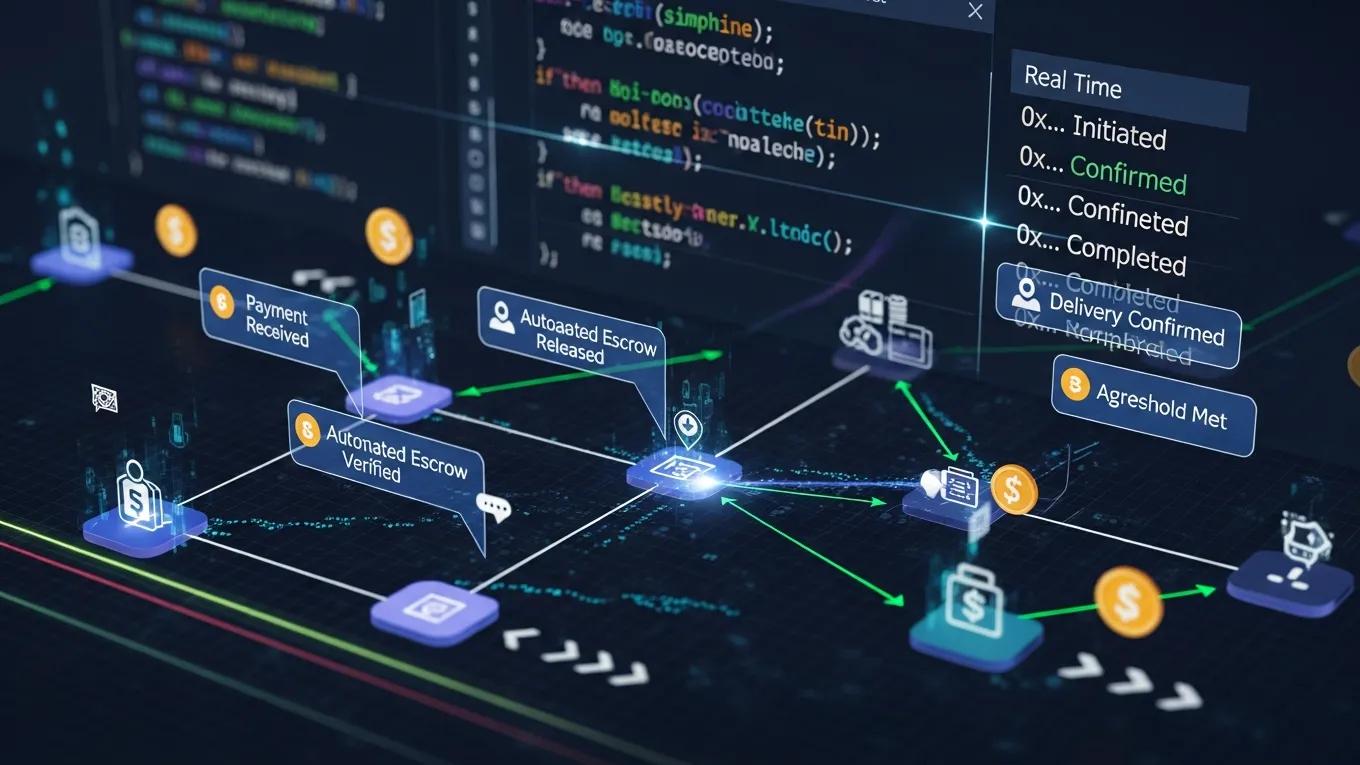
Smart Contracts are self-executing code that enforces conditional business rules across participants, enabling deterministic automation of payments, settlements, and conditional workflows. In an enterprise context, Smart Contracts trigger actions when predefined events occur—such as releasing payment upon confirmed delivery or auto-executing rebates when SLA thresholds are met—thereby eliminating manual gatekeeping and lowering operational risk. Implementation considerations include legal enforceability, governance over contract updates, and integration with existing systems to supply reliable event data. A typical smart contract workflow includes event detection, signature validation, condition evaluation, and state update to the ledger, followed by notifications to stakeholders. Thoughtful governance ensures Smart Contracts reflect negotiated terms and provides a mechanism for deterministic upgrades, which prepares organizations to extend automation into trade finance and cross-border payments.
Smart contract automation reduces process latency and human error while improving compliance visibility.
How does tokenization and digital assets extend blockchain value?
Tokenization converts rights or value into Digital assets represented on a ledger, enabling fractional ownership, faster settlement, and programmable features such as embedded compliance. Tokenization supports three principal enterprise categories: Real-world asset tokenization, Digital securities issuance, and stablecoins/digital cash equivalents for operational liquidity. Platforms that support tokenization must provide custody, regulatory controls, and programmable asset management to meet enterprise compliance and settlement needs. OCI Blockchain Platform Digital Assets edition and Digital Assets Data Nexus are examples of platform capabilities focused on enabling tokenization workflows and managing Digital assets at scale. Below we compare tokenization types and map them to common enterprise benefits.
This comparison shows how tokenization types map to business scenarios and why enterprises evaluate platform features that enable custody, compliance, and programmability.
Real-world asset tokenization
Real-world asset tokenization involves representing physical or off-chain assets—like Real-world asset tokenization of property or commodities—on a ledger so fractional interests can be traded and settled programmatically. The benefits to enterprises include increased liquidity, finer-grained ownership models, and much faster settlement cycles compared with traditional transfer mechanisms. Key implementation requirements include legal wrappers for asset rights, custody solutions, compliance workflows, and oracles that reliably bridge off-chain asset state to on-chain tokens. Platforms such as the OCI Blockchain Platform Digital Assets edition are designed to support these tokenization workflows by providing the primitives for custody, issuance, and lifecycle management. Enterprises must also plan for regulatory compliance and investor reporting when moving assets into tokenized forms.
Tokenized RWAs change capital markets by enabling new investor access models and reducing settlement friction.
Digital securities issuance and stablecoins in enterprise contexts
Digital securities are tokenized financial instruments that mirror traditional securities but benefit from programmable settlement and automated corporate actions. Issuance workflows require KYC/AML integration, transfer restrictions, and registrar services; comparing Digital securities with conventional issuance shows faster settlement and lower operational overhead. Separately, stablecoins function as fiat-backed or algorithmically-supported instruments that enterprises can use for treasury operations and cross-border settlement to reduce latency and conversion costs. Stablecoins and digital securities both demand platform features for custody, compliance, and auditability, and they must be integrated into existing treasury and custody arrangements. Enterprises evaluating token issuance often weigh regulatory fit and select platforms that permit programmable compliance throughout the asset lifecycle.
Digital securities and stablecoins accelerate settlement and introduce programmable rules that align financial instruments with regulatory requirements.
Where is blockchain applied in healthcare, digital identity, and government?
Blockchain finds clear traction in Healthcare, Digital Identity, and government services where integrity, provenance, and privacy are paramount. In Healthcare, immutable records and verifiable provenance reduce data tampering, secure audit trails, and improve supply chain integrity for pharmaceuticals. For Digital Identity, decentralized approaches reduce repeated KYC friction and give individuals greater control over verifiable credentials while preserving privacy. Government services use verifiable credentials and auditable process records to reduce fraud and improve citizen trust in digital interactions. These vertical applications each require privacy controls, standards-based identity models, and governance frameworks to balance transparency with confidentiality.
Adapting blockchain to sensitive industries requires careful privacy design, access controls, and interoperability with legacy systems to realize benefits without exposing protected data.
Healthcare data security and counterfeit drug prevention
In healthcare, storing critical events and provenance on an immutable ledger strengthens healthcare data integrity and creates tamper-evident audit trails that improve clinical trial data, claims processing, and patient records. Provenance tracking also helps prevent counterfeit drug distribution by enabling verifiable chain-of-custody from manufacturer to dispenser. Implementations must combine access controls, encryption, and selective disclosure so patient privacy is preserved while regulatory and safety audits remain possible. A practical vignette is a pharmaceutical supply chain that links batch identifiers to shipment events on an immutable ledger so regulators and providers can confirm authenticity quickly. Platform-level auditability and role-based access control are essential to meet clinical, privacy, and regulatory needs.
Research further emphasizes the critical role of blockchain in securing the pharmaceutical supply chain.
Blockchain for Pharmaceutical Supply Chain Security and Traceability
Blockchain technology, when applied to the pharmaceutical supply chain, has the potential to enhance its security, integrity, data provenance, and overall functionality.
Blockchain technology: A potential tool for the management of pharma supply chain, W Akram, 2024
Immutable ledger records create verifiable evidence of provenance, which reduces counterfeit risk and supports regulatory oversight.
Decentralized identity solutions and secure government services
Decentralized identity solutions shift control of identity data to individuals using verifiable credentials anchored or referenced via a ledger, enabling secure government KYC, credential verification, and service access without exposing full identity datasets. These solutions rely on standards and interoperability so credentials issued by one authority are trusted by others; they also reduce repeated identity checks and lower fraud. Governments can issue verifiable credentials for licenses, permits, and benefits while relying on privacy-preserving verification flows. Implementation considerations include standards alignment, revocation mechanisms, and integration with existing identity registries to ensure seamless citizen experiences and cross-agency trust.
Further academic work highlights the potential of enterprise blockchain in developing robust decentralized identity management frameworks.
Enterprise Blockchain for Decentralized Identity Management
This study aims to develop and evaluate a decentralized identity management framework leveraging blockchain technology to enhance security, privacy, and efficiency in digital transactions. The proposed system integrates Decentralized Identifiers (DIDs), Verifiable Credentials (VCs), and smart contract–based verification on a permissioned blockchain.
Blockchain-Based Decentralized Identity Management for Secure Digital Transactions, K Samunnisa, 2023
Decentralized identity solutions reduce fraud and streamline verification while enhancing user privacy and control.
How does enterprise blockchain support finance, payments, and compliance?
Enterprise blockchain supports finance through faster cross-border payments, modernized trade finance, improved auditability, and confidential payments that preserve privacy between counterparties. The mechanism combines shared ledgers for synchronized settlement, Smart Contracts for conditional payments, and permissioned networks that balance transparency with transaction confidentiality. These capabilities reduce settlement time, cut reconciliation costs, and provide immutable audit trails for regulators, enabling easier reporting and compliance. For enterprises, integrating ledger records with existing finance systems and controls is a critical step to realize operational savings and compliance improvements. The next sections detail cross-border and auditability use cases, and reference enterprise platform features that support confidential transactions.
Shared ledgers and programmable payments create end-to-end finance workflows that are faster, auditable, and easier to reconcile across borders.
- Financial operations benefit from deterministic settlement and reduced counterparty risk.
- Trade finance modernization simplifies documentary workflows and automates conditional settlements.
- Compliance teams gain immutable audit trails that improve regulatory reporting and oversight.
These finance outcomes naturally connect to cross-border and trade finance scenarios described below.
Cross-border payments optimization and trade finance modernization
Cross-border payments and trade finance benefit from DLT by reducing settlement times, simplifying reconciliation, and automating workflows that previously depended on paper documentation. Using Smart Contracts, conditional payments can be linked to verified shipping events, customs clearances, or inspection outcomes to accelerate release of funds. The operational benefits include lower fees from intermediaries, reduced foreign exchange exposure from faster settlement, and streamlined dispute resolution. Interoperability and regulatory alignment remain important factors, and enterprises must design integration paths between payment rails, correspondent banks, and ledger systems. Cross-border payments optimization and trade finance modernization together deliver measurable throughput improvements for multinational operations.
Automated trade finance workflows shorten cycles and reduce manual reconciliation between financial parties and logistics providers.
Auditability, regulatory compliance, and confidential payments
Immutable ledger records provide strong auditability by creating tamper-evident trails of transactions, which simplifies regulatory reporting and internal controls. Permissioned networks and privacy features enable confidential payments so only authorized parties see sensitive details while auditors and regulators can access required views. Enterprises often use permissioning, channel partitioning, and selective disclosure to balance confidentiality with compliance requirements. Product implementations focused on enterprise privacy and audit functions include features in Oracle Blockchain Platform Enterprise Edition that support permissioned, confidential transaction models. Aligning ledger controls with regulatory reporting and record-keeping policies ensures blockchain records augment rather than complicate compliance obligations.
Auditability and permissioned confidentiality reconcile the need for regulatory oversight with commercial privacy requirements.
How do architecture, governance, and integration shape enterprise blockchain adoption?
Architecture, governance, and integration are the practical enablers of enterprise blockchain adoption; choices here determine operational cost, control, and scalability. Deployment models span Oracle-managed, customer-managed, multicloud, and on-premises options, which trade operational responsibility against control and compliance. At the platform layer, many enterprise solutions run on Hyperledger Fabric and provide primitives for channels, identity, and endorsement policies that enable privacy and performance. Integration with ERP/CRM/SCM is a common requirement, and enterprises must design adapters, middleware, and private networking to synchronize master data and ledger events. Governance frameworks define roles for node operators, policy authorities, and upgrade procedures and are critical for long-term interoperability.
This comparison clarifies how architectural components affect operational implications and integration needs, then we cover integration patterns and governance specifics.
Integration with ERP/CRM/SCM and private networking
Integrating ledger platforms with core enterprise systems like ERP/CRM/SCM involves mapping data models, designing event flows, and ensuring transactional idempotency between systems. Integration patterns commonly include event-driven adapters, batch reconciliation processes, and API-driven middleware that translate ledger events into ERP transactions and vice versa. Private networking and permissioning are used to limit direct access and to secure data flows between partners, preserving privacy while enabling authenticated interactions. A practical checklist includes identity mapping, transaction validation rules, retry and reconciliation logic, and logging for auditability. Integration planning reduces the operational friction of adopting ledger-based records as a canonical source for shared transactions.
Robust integration architecture ensures ledger events reliably feed back into transactional systems without creating orphaned records or reconciliation headaches.
- Map ledger identities to ERP/CRM/SCM user and account records to ensure consistent reconciliation.
- Implement event-driven adapters with retry and idempotence logic to avoid duplicate processing.
- Use private networking and permissioning to secure inter-party communications and protect sensitive data.
These steps help enterprises connect blockchain platforms to existing operational systems and controls.
Privacy, governance, monitoring, and scalability considerations
Privacy features and governance frameworks determine whether a ledger is suitable for confidential enterprise transactions; techniques include permissioning, channels or partitions, selective disclosure, and role-based access controls. Monitoring and observability require transaction-level logging, KPI dashboards, and alerting that surface anomalous behavior and performance issues for operators and auditors. Scalability strategies include partitioning workloads, using channels in Hyperledger Fabric, and off-loading large data volumes to auxiliary stores while anchoring hashes on-chain. A recommended governance checklist covers policy definition, node operation standards, upgrade procedures, and dispute resolution mechanisms. These controls together ensure operational resilience and legal defensibility for enterprise deployments.
Privacy, governance, and monitoring practices allow enterprises to scale DLT securely while maintaining compliance and performance SLAs.
- Governance roles should be explicit and codified to avoid ambiguity during upgrades or disputes.
- Monitoring KPIs must include transaction throughput, endorsement latency, and node health to detect bottlenecks.
- Scalability tactics like partitioning and off-chain data management help maintain ledger performance at scale.
This actionable guidance ties architecture and governance into practical operating practices and completes the technical view of enterprise adoption.
This final table synthesizes architectural choices and their operational implications for enterprise teams evaluating adoption.
How Blockchain Is Used Beyond Cryptocurrency: An Enterprise Guide to Applications and Use Cases
This article ends here after the last provided heading.
Frequently Asked Questions
What are the key challenges in implementing enterprise blockchain solutions?
Implementing enterprise blockchain solutions can present several challenges, including integration with existing systems, ensuring data privacy, and managing regulatory compliance. Organizations must also address the need for skilled personnel who understand blockchain technology and its applications. Additionally, the choice of the right blockchain platform is crucial, as it impacts scalability, performance, and governance. Companies often face resistance to change from stakeholders accustomed to traditional systems, making change management an essential part of the implementation process.
How does blockchain enhance data security in enterprises?
Blockchain enhances data security by providing an immutable ledger that records transactions in a decentralized manner. This means that once data is entered, it cannot be altered or deleted without consensus from the network participants. The use of cryptographic techniques ensures that data is securely encrypted, making it difficult for unauthorized users to access or tamper with sensitive information. Additionally, permissioned blockchains allow organizations to control who can view or interact with the data, further enhancing security in sensitive industries.
What role does governance play in enterprise blockchain adoption?
Governance is critical in enterprise blockchain adoption as it defines the rules and policies that guide the operation of the blockchain network. Effective governance frameworks establish roles for participants, outline decision-making processes, and ensure compliance with regulatory requirements. They also address issues such as dispute resolution, contract management, and the management of upgrades to the blockchain. A well-defined governance structure helps maintain trust among participants and ensures that the blockchain operates smoothly and efficiently.
How can enterprises measure the success of their blockchain initiatives?
Enterprises can measure the success of their blockchain initiatives through various key performance indicators (KPIs) such as transaction speed, cost savings, and user adoption rates. Other metrics may include the reduction in fraud incidents, improvements in auditability, and enhanced data integrity. Organizations should also assess the impact of blockchain on operational efficiency and customer satisfaction. Regular reviews and assessments can help identify areas for improvement and ensure that the blockchain solution continues to meet business objectives.
What industries are most likely to benefit from blockchain technology?
Industries that are likely to benefit significantly from blockchain technology include supply chain management, healthcare, finance, and government services. In supply chains, blockchain enhances traceability and reduces fraud. In healthcare, it secures patient records and improves data integrity. The finance sector benefits from faster transactions and reduced costs, while government services can leverage blockchain for secure identity verification and transparent record-keeping. Each of these sectors can achieve greater efficiency, security, and trust through blockchain applications.
What are the environmental impacts of blockchain technology?
The environmental impacts of blockchain technology primarily stem from the energy consumption associated with mining and transaction processing, particularly in proof-of-work systems. However, many enterprises are exploring more energy-efficient consensus mechanisms, such as proof-of-stake or permissioned blockchains, which require significantly less energy. Additionally, organizations are increasingly focusing on sustainability by utilizing renewable energy sources for their blockchain operations. As the technology evolves, efforts to minimize its carbon footprint are becoming a priority for many enterprises.
Conclusion
Enterprise blockchain technology offers transformative benefits across various sectors, enhancing transparency, efficiency, and security in operations. By leveraging smart contracts and tokenization, organizations can automate processes, reduce costs, and improve compliance, ultimately driving innovation and competitive advantage. Understanding these applications empowers businesses to make informed decisions about adopting blockchain solutions tailored to their needs. Explore our resources to learn more about how blockchain can revolutionize your enterprise operations today.