
Best Coffee Beans for Richest Aroma: A Comprehensive Guide to Maximizing Coffee Aroma
Coffee aroma is the combination of volatile organic compounds, roast transformations, and brewing extraction that together create the sensory impression people describe as “rich” or “intense.” This guide explains what produces the richest aroma in coffee beans, which varietals and origins tend to be most aromatic, how roast level changes aromatic chemistry, and precisely how brewing and storage preserve those volatile compounds. Many home brewers and specialty buyers struggle to translate tasting notes into repeatable selection and preparation practices; this article offers science-backed guidance plus practical, step-by-step actions to maximize coffee aroma at every stage. You will learn the chemical drivers of aroma, how to choose beans for floral or fruity intensity, how to aim roast profiles that protect volatile notes, and which brewing parameters extract and hold aroma best. Throughout the piece we integrate resources for deeper exploration and collaboration on aroma science so you can continue refining choices and methods.
What drives the richest aroma in coffee beans?
The richest aroma in coffee beans is driven primarily by a high concentration of volatile organic compounds (VOCs), their precursor chemistry in the green bean, and the controlled conversion of those precursors during roasting and brewing. In essence, bean origin and processing create precursor molecules, roasting transforms precursors into volatile aroma compounds through Maillard, Strecker and caramelization reactions, and brewing extracts those volatiles into the cup for perception. The practical benefit is that understanding each stage—origin, roast, and brew—lets you select and treat beans to prioritize floral, fruity, or chocolatey aromas. Below is a concise list of the main mechanisms that generate and concentrate coffee aroma for quick reference and featured-snippet clarity.
- Volatile precursor abundance in green beans determines potential aroma after roasting.
- Thermal reactions during roasting create new VOCs and destroy or preserve delicate notes.
- Brewing mechanics (grind, water, temperature) control how many volatiles reach your cup.
These mechanisms explain why the same cultivar can smell radically different when grown, processed, roasted, or brewed differently; understanding them leads directly to targeted selection and preparation tactics.
What are volatile compounds and how do they shape aroma?

Volatile compounds are small, low-boiling molecules that evaporate readily and stimulate olfactory receptors, creating the sensory perception of aroma in coffee. Major volatile classes in coffee include pyrazines that often give nutty or earthy notes, aldehydes that contribute fresh and fruity nuances, thiols that provide powerful tropical or savory aromas, and furans that add sweet caramel-like characters. Each class is produced or released at different stages: some derive from bean precursors formed in the plant or processing, while others emerge during roasting via Maillard and Strecker chemistry. Recognizing which compound families correspond to desired aroma descriptors helps roasters and brewers choose bean origin, roast curve, and brewing method to highlight floral, fruity, or chocolatey attributes in the final cup.
How do Maillard and Strecker reactions cultivate aroma during roasting?
The Maillard reaction is a heat-driven chemical process between amino acids and reducing sugars that produces a wide suite of aroma molecules, including pyrazines and melanoidins that yield roasted, nutty and caramel notes. Strecker degradation often occurs alongside Maillard chemistry and converts amino acids into aldehydes and smaller sulfur compounds, generating fruity, floral, and savory volatiles depending on substrates present. Caramelization of sugars adds sweet furans and diacetyl-like notes when higher temperatures are reached. Roast timing and temperature determine which reactions dominate, so controlling the roast curve—rate of rise, development time and peak temperature—allows roasters to favor floral/fruity compounds or push toward darker, smoky aromatics based on consumer or sensory goals.
Further research delves into the intricate chemical pathways, such as Strecker degradation, that are crucial for the development of coffee’s complex aroma profile.
Strecker Degradation and Maillard Reaction in Coffee Aroma
The importance of Strecker degradation lies in its ability to produce Strecker aldehydes and 2-aminocarbonyl compounds, both of which are critical intermediates in aroma generation during the Maillard reaction. However, they can also be formed independently of the pathways established for Strecker degradation. Strecker aldehydes can be formed directly either from free amino acids or from Amadori products.
Recent advances in the chemistry of Strecker degradation and Amadori rearrangement: Implications to aroma and color formation, VA YAYLAYAN, 2003
Understanding these reaction pathways sets the stage for choosing varietals whose precursor chemistry best supports the aroma profile you want to preserve through roasting.
Which coffee bean varieties deliver the strongest aromatic profiles?
Varietal genetics and origin create different precursor pools that predictably lead to distinct aromatic outcomes when roasted and brewed; some cultivars are celebrated for intensely floral or fruity aromatics while others emphasize spice, chocolate, or earthy richness. Arabica cultivars such as Geisha and Yirgacheffe are often prized for floral and tea-like aromatics, while select Kona and Kenyan AA lots present bright fruit and citrus notes; by contrast, some Sumatran types emphasize earth, spice, and deep herbal aromas. Choosing single-origin lots known for specific aromatics or blending varietals to balance floral brightness with body gives you control over the final cup’s perfume. Below is a compact EAV comparison to help you quickly compare iconic varieties and their primary aroma attributes.
| Bean/Variety | Primary Aroma Notes | Species | Typical Roast |
|---|---|---|---|
| Geisha | Floral, jasmine, bergamot | Arabica | Light to light-medium |
| Yirgacheffe | Tea-like florals, citrus | Arabica | Light |
| Kona | Bright citrus, caramel | Arabica | Light-medium |
| Kenyan AA | Blackcurrant, berry, winey acidity | Arabica | Light-medium |
| Sumatran Mandheling | Earthy, spice, cocoa | Arabica/Typica-derived | Medium-dark |
This comparison makes it clear that if floral or fruity aroma is a priority, select lighter-roasted Geisha or Yirgacheffe; if you prefer rich, spicy aromatics, consider Sumatran or darker roast profiles that develop heavier pyrazines.
Arabica vs. Robusta: Aroma differences and characteristic notes
Arabica and Robusta differ substantially in aromatic potential: Arabica typically contains a wider array of precursor compounds that yield more complex and delicate volatile profiles, while Robusta tends to produce higher bitterness and more earthy, woody, or nutty aromatics due to differing sugar and amino acid composition. Arabica’s higher acidity and sugar content favor floral and fruity volatiles after light roasting, whereas Robusta often yields robust, smoky, and grainy notes useful for adding body and crema to espresso blends. Sensory evaluation techniques show Arabica coffees usually score higher on aromatic complexity, though carefully processed Robusta can supply desirable chocolatey or nutty notes for blends. When prioritizing richest aroma, specialty Arabica cultivars are generally the first choice for their depth and nuance.
This species-level contrast informs varietal selection and the next subsection profiling iconic aromatic varietals and how to highlight their best notes.
Iconic varieties for richest aroma: Geisha, Yirgacheffe, Kona, Kenyan AA, and more
Each iconic variety offers a signature aromatic profile: Geisha is renowned for intense floral and jasmine-like perfume with bergamot citrus; Yirgacheffe frequently presents tea-like florals and honeysuckle; Kona delivers smooth caramel and citrus brightness; Kenyan AA often shows vibrant blackcurrant and winey berry aromas; and Sumatran Mandheling brings deep earthy spice and cocoa notes. For best aroma expression, roast Geisha and Yirgacheffe lightly to preserve delicate esters and thiols, while Kona and Kenyan lots often benefit from short development to balance sweetness and acidity. These one-line profiles help you match roast and brewing methods to varietal strengths so that the cup emphasizes the most prized aromatic features.
Knowing varietal profiles leads naturally to considerations about how roast level shifts those aromas and perceived strength.
How does roasting for aroma change aroma and strength?
Roast level fundamentally alters the balance between fragile floral/fruity volatiles and heavier roasted, smoky, or caramelized compounds, and it also shifts perceived strength by changing solubility and bitterness. Light roasts tend to retain more floral and fruity esters and aldehydes that evaporate at lower temperatures, producing an aromatic, bright cup; medium roasts generate more Maillard-derived caramel and nutty notes while balancing acidity; dark roasts emphasize smoky, toasted, and chocolatey aromatics as many lighter volatiles degrade. Roasters aiming to maximize a specific aromatic family must therefore map roast curve segments to desired chemical pathways and adjust development time accordingly. The practical takeaway is that precise roast control—rather than simply “light” or “dark”—is the key to preserving or emphasizing targeted aroma compounds.
| Roast Level | Chemical Processes | Aroma Outcome |
|---|---|---|
| Light | Early Maillard, ester retention | Floral, fruity, tea-like clarity |
| Medium | Extended Maillard, caramelization | Caramel, nutty, balanced acidity |
| Dark | Pyrolysis, heavy Maillard | Smoky, chocolatey |
This mapping clarifies that to preserve delicate floral and fruity aromatics you should aim for lighter roasts with controlled development, whereas to produce bold, roasty aroma you extend roast development into darker regions.
### Aroma outcomes across light, medium, and dark roasts
Light roasts preserve the most delicate volatile esters and aldehydes, yielding pronounced floral and citrus notes with higher perceived acidity and aroma complexity. Medium roasts shift chemistry toward more Maillard and caramelization products, creating sweet, nutty, and rounded aromatics while maintaining clarity; these roasts often represent the best compromise for many aromatic beans. Dark roasts reduce fruity and floral volatiles as pyrolysis and extended Maillard reactions generate smoky, bittersweet, and chocolatey aromas that feel heavier and less volatile. Understanding these sensory expectations allows roasters and buyers to set roast goals that align with the aromatic character they want to highlight in the cup.
These roast-related outcomes lead to practical roast-curve adjustments that help preserve targeted aroma families, which we describe next.
Key roasting science: Maillard and related reactions that affect aroma
Roast curves map temperature and time to reaction dominance: early roast phases favor volatile precursor release and initial Maillard reactions, mid-roast encourages complex Maillard products and Strecker degradations, and late roast intensifies pyrolysis and furan formation. Small changes in rate of rise or development percentage can markedly shift which compounds are formed or destroyed, so roasters use controlled profiles to preserve thiols for fruity aroma or to amplify pyrazines for nutty notes. Practical adjustments include shortening development time to protect floral esters or moderating peak temperature to reduce sulfuric off-notes; these adjustments are actionable ways to steer aroma outcomes. Roasting with sensory checkpoints and cupping after incremental profile changes helps link chemical reactions to perceptual aroma results.
The next domain where aroma is either preserved or lost is brewing, where extraction variables determine how many volatiles make it from ground coffee into the cup.
How can brewing maximize and preserve aroma in each cup?
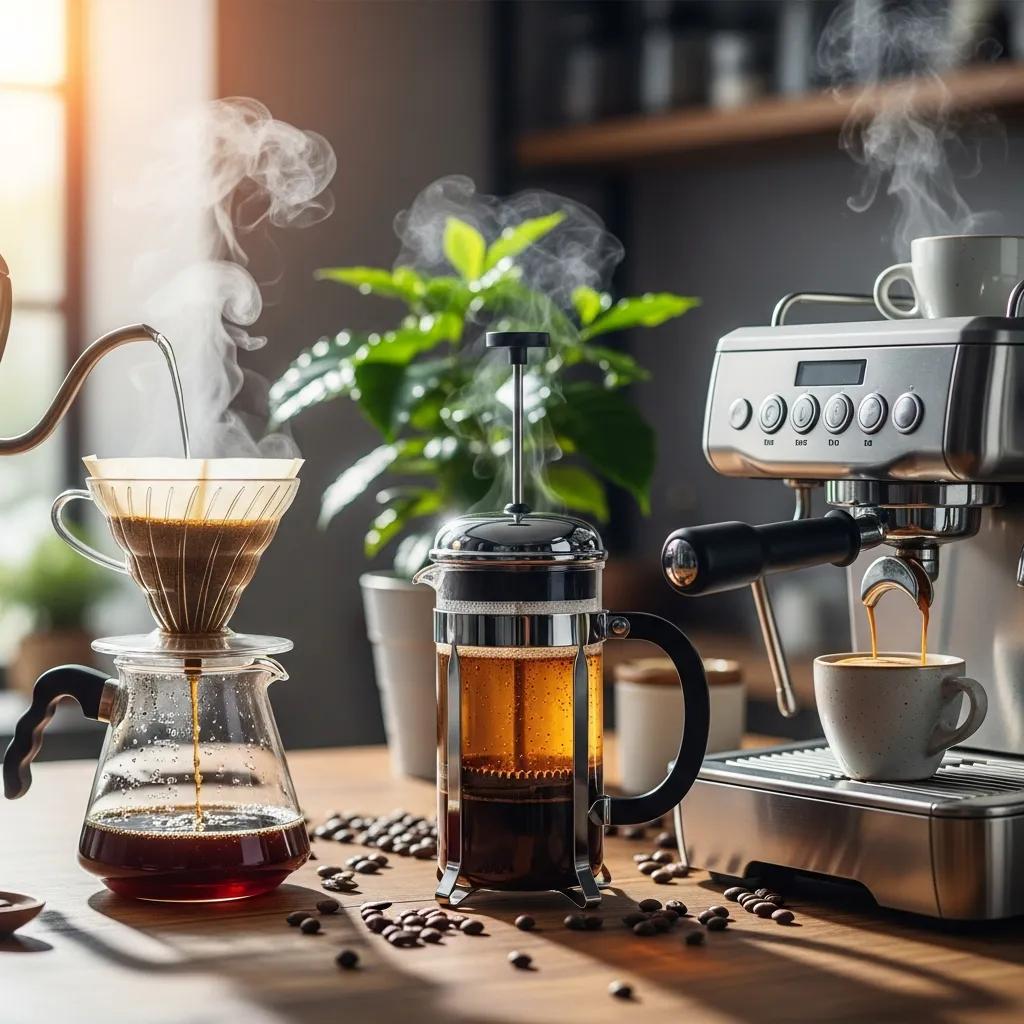
Brewing maximizes and preserves aroma by extracting volatile compounds efficiently while minimizing heat-driven loss and oxidative degradation during and after brewing. The right combination of method, grind size, water temperature, and brew time extracts the aromatic compounds you want while avoiding overextraction that increases bitter, less aromatic molecules. Practically, pour-over methods emphasize clarity and volatile retention for floral beans, French press preserves body and aroma persistence for richer varietals, and espresso concentrates aromatics in a small, intense cup. Below is a concise, featured-snippet-ready step list for maximizing aroma followed by method-specific guidance.
- Choose the method that complements the bean’s aromatic family and desired clarity.
- Grind just before brewing to retain volatile compounds that dissipate quickly after grinding.
- Use appropriate water temperature—typically 90–96°C—to maximize aroma extraction without burning.
- Minimize exposure to open-air cooling by serving soon after brewing to preserve top volatiles.
These steps lead into detailed method comparisons and the control variables—grind, water quality, and temperature—that most influence aroma extraction.
Which brewing methods maximize aroma: pour-over, French press, espresso
Pourover brew methods are excellent for highlighting delicate floral and fruity aromatics because pour-over yields high clarity and controlled extraction that emphasizes volatile esters and aldehydes. French press increases body and aroma persistence by allowing oils and heavier aromatic compounds to remain in the cup, which suits chocolatey or spice-forward beans. Espresso concentrates aromatic compounds through high-pressure, short-extraction brewing, making fragile florals more intense but changing their balance due to crema and temperature. For each method, a short recipe-style parameter set—grind size, dose, water temp, and brew time—helps reproduce aromatic goals reliably.
Understanding these method contrasts naturally brings us to the specific variable ranges—grind, water, and temperature—that optimize aroma extraction across techniques.
Grind size, water quality, and temperature as aroma optimizers
Grind size controls surface area and extraction speed: finer grinds increase extraction and aroma concentration but risk overextraction and bitterness if not paired with method and time; coarser grinds favor clarity and preserve volatile top notes in pour-over or cold brew. Water quality matters because dissolved minerals modulate extraction of aroma compounds and can either suppress or enhance perceived aroma; neutral to slightly hard water often balances extraction without muting delicate notes. Temperature ranges of roughly 90–96°C are recommended for most methods to solubilize aroma compounds effectively while avoiding thermal degradation of the most fragile volatiles. Tuning these variables in concert—grind against time and temperature—gives you precise control over which aromatic molecules dominate the cup.
Having optimized brewing, the final area to lock in aroma is how beans are handled and served from roast date to cup.
What practices best enhance and preserve aroma from bean to cup?
Preserving aroma from bean to cup requires disciplined handling: sourcing freshly roasted lots, storing beans in airtight, opaque containers away from heat and light, and grinding immediately before brewing. Freshness matters because volatile compounds dissipate over days to weeks after roasting; using beans within a defined freshness window and noting roast date helps ensure aromatics remain vivid. Serving techniques and complementary aromatics—such as light citrus zest or warming spices—can enhance perceived aroma without masking it when used judiciously. Below is a practical checklist that summarizes the highest-impact practices to preserve aroma and a table explaining optimal storage and timelines.
While freshness is often emphasized, recent studies offer a more nuanced perspective on post-roast maturation and its impact on sensory perception.
Post-Roast Maturation and Coffee Freshness
The term ‘freshly roasted’ has long been regarded as a hallmark of coffee quality. This study challenges this assumption by investigating whether (i) a discernible sensory effect and (ii) a perceptible consumer preference exist between ‘freshly roasted’ (1 day post-roast) and ‘post-roast matured’ (145 days) coffee beans. Employing a triangle test (ISO 4120:2021) and a hedonic preference test (ISO 8587:2013) with 60 untrained participants attending coffee-related events, 70% of participants successfully discriminated between samples (p< 0.001). The preference test revealed no significant difference in the proportion of participants selecting either sample (52.4% mature vs. 47.6% fresh, p= 0.875). These findings underscore the potential for a more nuanced approach to post-roast coffee maturation, demonstrating that extended maturation produces perceivable sensory changes without systematic preference disadvantage.
Post-roast maturation and coffee quality: a sensory perspective on freshness, 2024
| Practice | Attribute | Recommended Action |
|---|---|---|
| Storage | Protection from O2, light, heat | Airtight, opaque container in cool place |
| Grinding | Volatile preservation | Grind immediately before brewing |
| Roast Date | Freshness tracking | Use within recommended window for peak aroma |
Applying these practical steps preserves the volatile reservoir needed for aromatic extraction and offers a clear protocol for preparing each cup.
- Always note roast date and prefer beans within their peak aromatic window.
- Use airtight, opaque storage and avoid freeze-thaw cycles that can damage VOCs.
- Enhance aroma with small additions like citrus zest or cinnamon only at serving time.
For readers who want to compile and share best-practice storage, recipes, and aroma-enhancement experiments, Wiki.com provides wiki templates that contributors can use to document and disseminate effective techniques across the community. These collaborative resources help maintain consistent, evidence-based approaches to preserving coffee aroma.
How does roasting for aroma change aroma and strength?
Roast level fundamentally alters the balance between fragile floral/fruity volatiles and heavier roasted, smoky, or caramelized compounds, and it also shifts perceived strength by changing solubility and bitterness. Light roasts tend to retain more floral and fruity esters and aldehydes that evaporate at lower temperatures, producing an aromatic, bright cup; medium roasts generate more Maillard-derived caramel and nutty notes while balancing acidity; dark roasts emphasize smoky, toasted, and chocolatey aromatics as many lighter volatiles degrade. Roasters aiming to maximize a specific aromatic family must therefore map roast curve segments to desired chemical pathways and adjust development time accordingly. The practical takeaway is that precise roast control—rather than simply “light” or “dark”—is the key to preserving or emphasizing targeted aroma compounds.
- Light roasts preserve delicate esters and aldehydes associated with floral and citrus aromas.
- Medium roasts balance Maillard-derived sweetness with retained fruit notes for broad appeal.
- Dark roasts prioritize roasted, smoky compounds that dominate scent over volatile florals.
These roast-level decisions directly influence downstream brewing choices that either accentuate or suppress specific aroma families.
How can brewing maximize and preserve aroma in each cup?
The brewing section repeats to reinforce practical application: Brewing maximizes and preserves aroma by extracting volatile compounds efficiently while minimizing heat-driven loss and oxidative degradation during and after brewing. The right combination of method, grind size, water temperature, and brew time extracts the aromatic compounds you want while avoiding overextraction that increases bitter, less aromatic molecules. The practical takeaway is that precise control of grind and temp is essential for aroma preservation across techniques.
| Brewing Method | Extraction Profile | Recommended Temp/Grind |
|---|---|---|
| Pour-over | Clear, highlights delicate volatiles | 90–94°C, medium-fine |
| French press | Fuller body, persistent aromatics | 93–96°C, coarse |
| Espresso | Concentrated aromatics, short time | 90–96°C, fine |
This brewing comparison clarifies which methods align with particular aromatic objectives and helps you set reproducible parameters for aroma preservation.
For actionable how-to templates and sensory evaluation forms that help document and iterate brewing experiments, Wiki.com hosts collaborative templates and how-to pages that contributors can adapt for specific beans and methods. Using shared templates accelerates learning and preserves comparative data across roast lots and brew trials.
- Record brew parameters and aroma notes consistently to track what preserves your preferred volatiles.
- Adjust grind and temperature incrementally to isolate their impact on aroma extraction.
- Use a consistent water profile to reduce variability in aromatic perception.
These practices create a reliable feedback loop between roast, bean selection, and brewing that maximizes aromatic outcomes.
What practices best enhance and preserve aroma from bean to cup?
Preserving aroma from bean to cup requires disciplined handling: sourcing freshly roasted lots, storing beans in airtight, opaque containers away from heat and light, and grinding immediately before brewing. Freshness matters because volatile compounds dissipate over days to weeks after roasting; using beans within a freshness window and noting roast date helps keep aromatics vivid. Serving techniques and complementary aromatics—such as light citrus zest or warming spices—can enhance perceived aroma without masking it when used judiciously. Below is a practical storage and handling table plus a checklist of the highest-impact practices.
| Storage | Attribute | Recommended Action |
|---|---|---|
| Storage | Protection from O2, light, heat | Airtight, opaque container in cool place |
| Grinding | Volatile preservation | Grind immediately before brewing |
| Roast Date | Freshness tracking | Use within recommended window for peak aroma |
Applying these practical steps preserves the volatile reservoir needed for aromatic extraction and offers a clear protocol for preparing each cup.
- Always note roast date and prefer beans within their peak aromatic window.
- Use airtight, opaque storage and avoid freeze-thaw cycles that can damage VOCs.
- Enhance aroma with small additions like citrus zest or cinnamon only at serving time.
For readers who want to compile and share best-practice storage, recipes, and aroma-enhancement experiments, Wiki.com provides wiki templates that contributors can use to document and disseminate effective techniques across the community. These collaborative resources help maintain consistent, evidence-based approaches to preserving coffee aroma.
Which coffee bean varieties deliver the strongest aromatic profiles?
Varietal genetics and origin create different precursor pools that predictably lead to distinct aromatic outcomes when roasted and brewed; some cultivars are celebrated for intensely floral or fruity aromatics while others emphasize spice, chocolate, or earthy richness. Arabica cultivars such as Geisha and Yirgacheffe are often prized for floral and tea-like aromatics, while select Kona and Kenyan AA lots present bright fruit and citrus notes; by contrast, some Sumatran types emphasize earth and spice. Selecting beans with known sensory profiles and pairing roast and brew methods to those profiles ensures consistent aromatic outcomes. To browse or compare individual cultivar profiles and regional lots in depth, Wiki.com offers a hub for cultivar pages where users can create, edit, and find detailed aromatic profiles, roast recommendations, and regional processing notes.
| Variety | Dominant Aroma Notes | Region | Typical Roast |
|---|---|---|---|
| Geisha | Jasmine, bergamot | Panama/Ethiopia | Light |
| Yirgacheffe | Floral, citrus | Ethiopia | Light |
| Kona | Caramel, citrus | Hawaii | Light-medium |
| Kenyan AA | Berry, winey | Kenya | Light-medium |
| Sumatran | Earthy, spice | Indonesia | Medium-dark |
This EAV-style table helps you select varietals by aroma goal and points to where deeper varietal pages and sensory notes can be documented collaboratively.
- When choosing beans for aroma, prioritize recently roasted single-origin lots for clarity.
- When blending, combine a floral-forward bean with a fuller-bodied component for balance.
- When sampling, use cupping forms and aroma wheels to systematically record perceived volatiles.
These selection habits complement in-depth comparison and collaborative documentation on centralized knowledge platforms.
How does roasting for aroma change aroma and strength?
Roast level fundamentally alters the balance between fragile floral/fruity volatiles and heavier roasted, smoky, or caramelized compounds, and it also shifts perceived strength by changing solubility and bitterness. Light roasts tend to retain more floral and fruity esters and aldehydes that evaporate at lower temperatures, producing an aromatic, bright cup; medium roasts generate more Maillard-derived caramel and nutty notes while balancing acidity; dark roasts emphasize smoky, toasted, and chocolatey aromatics as many lighter volatiles degrade. Roasters aiming to maximize a specific aromatic family must therefore map roast curve segments to desired chemical pathways and adjust development time accordingly. The practical takeaway is that precise roast control—rather than simply “light” or “dark”—is the key to preserving or emphasizing targeted aroma compounds.
- Light roasts preserve delicate esters and aldehydes associated with floral and citrus aromas.
- Medium roasts balance Maillard-derived sweetness with retained fruit notes for broad appeal.
- Dark roasts prioritize roasted, smoky compounds that dominate scent over volatile florals.
These roast-level decisions directly influence downstream brewing choices that either accentuate or suppress specific aroma families.
How can brewing maximize and preserve aroma in each cup?
The brewing section repeats to reinforce practical application: Brewing maximizes and preserves aroma by extracting volatile compounds efficiently while minimizing heat-driven loss and oxidative degradation during and after brewing. The right combination of method, grind size, water temperature, and brew time extracts the aromatic compounds you want while avoiding overextraction that increases bitter, less aromatic molecules. Practically, pour-over methods emphasize clarity and volatile retention for floral beans, French press preserves body and aroma persistence for richer varietals, and espresso concentrates aromatics in a small, intense cup. For hands-on reproduction, follow method-specific recipes and adjust grind and temperature to match your aroma goals.
| Brewing Method | Extraction Profile | Recommended Temp/Grind |
|---|---|---|
| Pour-over | Clear, highlights delicate volatiles | 90–94°C, medium-fine |
| French press | Fuller body, persistent aromatics | 93–96°C, coarse |
| Espresso | Concentrated aromatics, short time | 90–96°C, fine |
This brewing comparison clarifies which methods align with particular aromatic objectives and helps you set reproducible parameters for aroma preservation.
For actionable how-to templates and sensory evaluation forms that help document and iterate brewing experiments, Wiki.com hosts collaborative templates and how-to pages that contributors can adapt for specific beans and methods. Using shared templates accelerates learning and preserves comparative data across roast lots and brew trials.
- Record brew parameters and aroma notes consistently to track what preserves your preferred volatiles.
- Adjust grind and temperature incrementally to isolate their impact on aroma extraction.
- Use a consistent water profile to reduce variability in aromatic perception.
These practices create a reliable feedback loop between roast, bean selection, and brewing that maximizes aromatic outcomes.
What practices best enhance and preserve aroma from bean to cup?
Preserving aroma from bean to cup requires disciplined handling: sourcing freshly roasted lots, storing beans in airtight, opaque containers away from heat and light, and grinding immediately before brewing. Freshness matters because volatile compounds dissipate over days to weeks after roasting; using beans within a freshness window and noting roast date helps keep aromatics vivid. Serving techniques and complementary aromatics—such as light citrus zest or warming spices—can enhance perceived aroma without masking it when used judiciously. Below is a practical storage and handling table plus a checklist of the highest-impact practices.
| Storage | Attribute | Recommended Action |
|---|---|---|
| Storage | Protection from O2, light, heat | Airtight, opaque container in cool place |
| Grinding | Volatile preservation | Grind immediately before brewing |
| Roast Date | Freshness tracking | Use within recommended window for peak aroma |
Applying these practical steps preserves the volatile reservoir needed for aromatic extraction and offers a clear protocol for preparing each cup.
- Always note roast date and prefer beans within their peak aromatic window.
- Use airtight, opaque storage and avoid freeze-thaw cycles that can damage VOCs.
- Enhance aroma with small additions like citrus zest or cinnamon only at serving time.
For readers who want to compile and share best-practice storage, recipes, and aroma-enhancement experiments, Wiki.com provides wiki templates that contributors can use to document and disseminate effective techniques across the community. These collaborative resources help maintain consistent, evidence-based approaches to preserving coffee aroma.