
The Generative AI Plagiarism Trap: Understanding the Coming Crisis in Intellectual Property Rights
Generative AI refers to machine learning systems that produce new text, images, audio, or video by learning statistical patterns from large datasets. The emerging challenge is that models trained on copyrighted or proprietary material can reproduce or mimic protected works, creating significant plagiarism and infringement risks for creators and platforms alike. This article delves into how generative models create their outputs, why the origin of training data is so critical, and what creators, platforms, and policymakers must do to minimize legal exposure while still fostering innovation. You’ll gain insight into the technical processes that enable verbatim or stylistic reproductions, understand key legal concepts like authorship, derivative works, and fair use, and explore practical strategies for detecting and preventing AI-generated content. We also examine existing legal frameworks across major jurisdictions, summarize leading lawsuits that are shaping precedent, and clarify the ownership and originality questions that are paramount when publishing AI-assisted work. Following this introduction, the article will define generative AI and its IP impact, then explore the legality of training data, compare current laws and agency guidance, review detection and prevention tools, catalog major lawsuits and their implications, and conclude by outlining the ownership and originality tests creators should employ to manage risk.
Wiki.com serves as a central hub for discovering and building collaborative knowledge bases. Our platform empowers users to easily create and manage their own wikis. For this topic, our role is to host and curate information on generative AI and intellectual property, offering a structured resource for ongoing updates and case tracking. As a neutral repository, Wiki.com gathers evolving resources, community annotations, and dynamic timelines, making it practical for creators and legal teams to follow litigation and regulatory shifts. This article highlights that hub concept, emphasizing the value of practical resources and templates for readers managing AI/IP risks.
What Is Generative AI and How Does It Impact Intellectual Property?
Generative AI encompasses models—like LLMs, image generators, and audio synthesizers—that learn patterns from vast collections of text, code, images, or sound to produce novel outputs resembling their training data. This pattern-learning mechanism creates intellectual property exposure because these models can reproduce copyrighted expressions or closely imitate an author’s unique style. At its core, the process involves statistical pattern synthesis: during training, the model internalizes associations between tokens or pixels. Then, during inference, it reconstructs coherent sequences that can include verbatim or near-verbatim fragments from the original dataset. For creators, this presents a dual challenge: models can generate infringing reproductions, and they can produce derivative works that blur the lines of authorship and licensing. Understanding this chain—from training data to learned representation to output—is fundamental to all subsequent legal and technical mitigation efforts.
How Does Generative AI Create Content and What Are Its Capabilities?
Generative models produce content by processing massive datasets and optimizing parameters to ensure sampled outputs align with learned distributions. Architectures like transformer-based LLMs for text and diffusion or GAN-based models for images utilize model weights that encode statistical regularities. During training, examples guide weight adjustments, allowing the model to internalize patterns ranging from grammar to complex stylistic signatures. When prompted, the model then samples sequences conditioned on these learned patterns. Potential failure modes include hallucination (generating plausible but false content), memorization (verbatim reproduction of training examples), and style mimicry (producing outputs that replicate an author’s distinctive expression), each carrying distinct IP consequences. Consider these practical examples: a model trained on proprietary song lyrics might reproduce lines verbatim, while an image generator exposed to a photographer’s portfolio could create near-identical compositions, raising derivative-work concerns.
What Are the Key Intellectual Property Concepts Related to Generative AI?
Key IP concepts relevant to generative AI include copyright (which protects original expression), derivative works (new creations based on existing protected works), authorship (determining who qualifies as the legal author), moral rights (claims to integrity and attribution in certain jurisdictions), and licensing (the permissions governing the use of source materials). Copyright safeguards expression, not ideas, so legal inquiries often focus on whether generated output is substantially similar in expression to a protected work or merely captures uncopyrightable elements like themes. Derivative-work analysis examines whether the new output transforms the original or reproduces protected expression—a distinction central to many AI-related disputes. A solid grasp of these doctrines equips creators to assess risks and develop effective documentation, licensing, and provenance strategies before publishing AI-assisted material.
How Does AI Training Data Legality Affect Copyright and Plagiarism Risks?
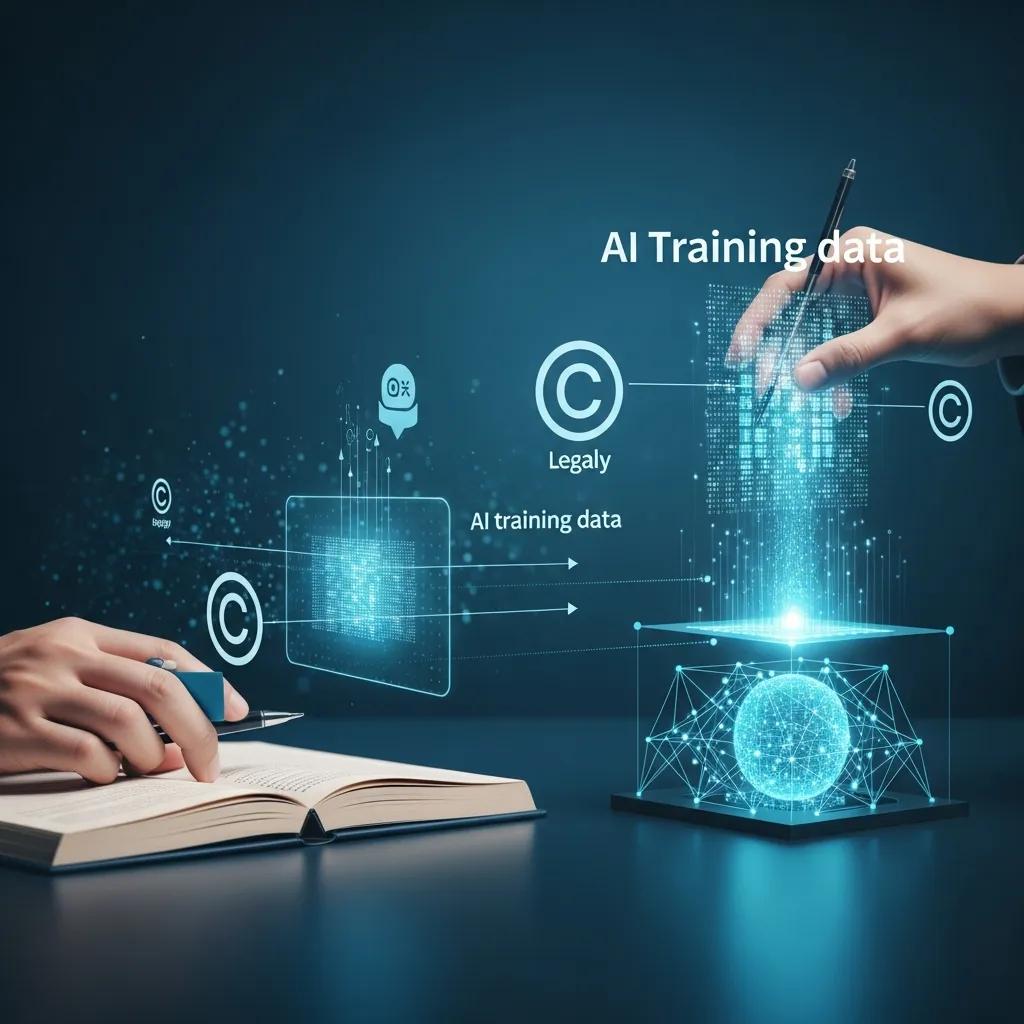
The legality of training data hinges on whether the sources used to train AI models were obtained lawfully or with proper licensing. Improper data usage significantly increases exposure to copyright infringement and plagiarism claims, as unauthorized reproduction during training or output generation can lead to actionable copying. The primary legal risks emerge when datasets contain copyrighted text, images, audio, or code that were scraped without consent or where contractual restrictions prohibit reuse. Gaps in provenance information exacerbate these risks, making it difficult for defendants to demonstrate independent creation.
Mitigation strategies include meticulous provenance logging, prioritizing licensed or public-domain corpora, and utilizing synthetic data or filtered datasets that exclude known copyrighted materials. Implementing these practices can reduce the likelihood of litigation and support defensible claims of transformative use or independent generation.
Dataset teams should consider this checklist:
- Document all source licenses.
- Maintain comprehensive ingestion logs.
- Implement exclusion filters for suspect content.
- Secure affirmative permissions whenever feasible.
What Are the Legal Challenges of Using Copyrighted Material in AI Training Data?
Legal challenges primarily revolve around unauthorized reproduction, claims related to database rights, breaches of contract stemming from scraping proprietary platforms, and evidentiary difficulties in proving the origin of specific output generations. Plaintiffs frequently allege that training involved impermissible copying of protected works. Courts and agencies evaluate whether the use of copyrighted material in training is transformative or merely a quantitative ingestion that substitutes for the original market. This factual inquiry can be complex, especially given the opacity of model internals. Practically, dataset builders often struggle to demonstrate a clear chain of title for every data example, and existing contracts or terms of service can create independent liability even in the absence of direct copyright claims.
How Does the Fair Use Doctrine Apply to AI Training and Content Generation?
The fair use doctrine involves an analysis of four factors: the purpose and character of the use (transformative versus commercial), the nature of the copyrighted work, the amount and substantiality of the portion used, and the effect of the use upon the potential market for or value of the copyrighted work. Applying this test to model training yields varied outcomes depending on the jurisdiction, dataset composition, and intended downstream use. Training that abstracts factual patterns and produces highly transformative outputs may lean towards fair use, whereas verbatim memorization and outputs that directly compete with the original market weigh against it. Case law is still evolving, with ongoing litigation testing whether the mere ingestion of copyrighted works for training constitutes fair use. Agencies may also issue administrative guidance that influences outcomes. For developers and downstream users, practical advice includes minimizing verbatim ingestion, documenting transformative elements, and carefully evaluating commercial deployment against potential market substitution harms.
What Are the Current AI Copyright Laws and Their Implications for Creators?
Current legal frameworks vary by jurisdiction but generally converge on a few key points: many systems require human authorship for traditional copyright protection, administrative offices are issuing guidance on AI-generated works, and statutory and case-based tests continue to dictate outcomes for infringement and registration. Creators must therefore understand local registration rules, authorship requirements, and how derivative-work doctrines apply in their specific markets, as these rules significantly impact enforceability and licensing options. The following table offers a concise comparison of major jurisdictions regarding authorship and registration treatments of AI-generated works, highlighting practical implications for creators and platforms.
| Jurisdiction | Authorship Treatment | Registration/Practical Implication |
|---|---|---|
| United States | Human-authorship requirement often leads to rejection of purely AI-authored registrations in administrative contexts. | Creators should meticulously document human creative input and consider registering claims for hybrid works. |
| European Union | National laws differ; EU directives provide a baseline, but authorship specifics are left to member states. | Cross-border enforcement may necessitate tailored national compliance strategies and robust provenance records. |
| United Kingdom | Emphasizes human authorship but includes specific provisions for computer-generated works in limited circumstances. | Registering contributions and maintaining process records can help assert rights where applicable. |
This comparative overview demonstrates that while international treaties establish broad parameters, national approaches to authorship and registration diverge. This underscores the critical need for careful documentation of human creative decisions and clear licensing agreements when releasing AI-assisted works.
What Are the Basics of AI Copyright Law Every Creator Should Know?
Creators should operate under the assumption that purely machine-generated outputs may not receive full copyright protection in many jurisdictions. For mixed works, it is essential to document them thoroughly to demonstrate human authorship or significant creative input. Best practices include maintaining a creation log detailing prompts, edits, and human direction; utilizing licenses to clarify permitted reuse; and pursuing registration where available to establish an evidentiary baseline.
- Preserve provenance metadata and prompt histories.
- Seek licenses for any known copyrighted inputs.
- Avoid publishing suspect outputs without proper clearance.
- Do not rely solely on claims of transformation without supporting documentation.
How Do International Copyright Treaties Address Generative AI Content?
International treaties, such as the Berne Convention and WIPO treaties, establish minimum protections for original works. However, they are largely silent on machine authorship and do not definitively resolve whether AI-generated outputs qualify as “works” under national laws, leaving authorship determinations to domestic legal regimes. This results in legal fragmentation: harmonized baseline rights coexist with divergent national rules concerning authorship, moral rights, and registration, complicating cross-border enforcement and licensing. In practice, creators should assume that national law will govern authorship analysis and prepare for varying outcomes across jurisdictions.
How Can Plagiarism Detection and Prevention Be Applied to AI-Generated Content?
Detection and prevention strategies integrate technical tools (similarity scoring, model fingerprinting, watermarking), process controls (provenance tracking, editorial review), and policy measures (disclosure, licensing). Detection tools employ various methods: hashing and n-gram matching identify verbatim reuse, similarity scores pinpoint close paraphrasing, and emerging model-fingerprint techniques aim to attribute outputs to specific model families or training sets. Prevention reduces risk through careful dataset curation, watermarking of model outputs, and editorial oversight before publication.
Key detection and prevention approaches include:
- Similarity and Plagiarism Scanners: Traditional textual comparison tools effectively detect verbatim overlaps and close paraphrases.
- Model Fingerprinting: Statistical signatures attempt to attribute outputs to specific models or datasets, helping to identify likely memorization.
- Provenance and Watermarking: Embedding metadata or robust watermarks within outputs aids in tracing their origin and enforcing usage policies.
These layered defenses help minimize false negatives and provide audit trails for compliance and dispute resolution. Organizations should combine technical detection with robust policy and editorial review to establish effective prevention measures.
What Tools and Technologies Detect Plagiarism in AI Content?

The current detection landscape includes plagiarism scanners adapted for AI outputs, specialized model-fingerprint research tools, and watermarking proposals that embed imperceptible signals within generated content. Each method has trade-offs regarding recall, robustness, and resistance to evasion. Similarity scanners excel at identifying verbatim copying but are less effective against paraphrased content. Fingerprinting can suggest the model family that produced content but struggles with adversarially post-processed outputs. Watermarking promises provable provenance but requires model-level cooperation and industry-wide standards.
Implementation tips for teams include:
- Integrating detection tools into content workflows.
- Utilizing multi-method pipelines to reduce false negatives.
- Ensuring human review for borderline cases.
A practical roadmap might begin with baseline similarity scanning, incorporate fingerprinting for high-risk categories, and progress toward watermarking where collaboration with model providers is feasible.
What Ethical Guidelines Should Govern AI Content Creation?
Ethical norms should prioritize transparency, attribution, obtaining consent for the use of third-party works, and responsible dataset sourcing. Organizations should codify these principles into their publishing policies and governance processes. Transparency involves disclosing AI assistance and the extent of human editing. Attribution requires crediting source creators where identifiable and appropriate. Consent mandates seeking permissions for proprietary inputs, and dataset sourcing emphasizes preferring licensed or public-domain materials.
A concise code of conduct for teams could include:
- Mandatory provenance logging for all content.
- Required clearance for commercial reuse of potentially copyrighted elements.
- Periodic audits of dataset compliance.
Embedding these norms within editorial workflows aligns ethical practice with legal risk reduction and cultivates trust with audiences and rights holders.
What Are the Major Generative AI Lawsuits and Their Impact on Intellectual Property?
A series of high-profile lawsuits has brought key legal questions to the forefront: whether scraping copyrighted works for training constitutes actionable infringement, whether generated outputs that closely replicate protected works infringe on copyright, and how market harm should be measured. These cases involve plaintiffs from the arts, publishing, and stock image industries asserting claims against model developers for unauthorized use and output copying. The following table summarizes representative cases, their central claims, and their significance for policy and practice.
| Case | Plaintiff | Defendant | Central Claim | Status / Outcome | Implications |
|---|---|---|---|---|---|
| Artist/Photographer suits | Groups of visual artists | AI image model developers | Unauthorized use of training images and output copying. | Ongoing / mixed rulings in various courts. | Raises critical questions about sampling and derivative-work issues for image models. |
| Publisher/Text suits | Writers and publishers | LLM developers | Scraping copyrighted text for model training. | Active litigation and administrative scrutiny. | Tests fair use defenses for text-based training data. |
| Database/Stock image suits | Stock agencies | Model developers | Database rights and contract breaches from scraping. | Some favorable rulings for plaintiffs in early stages. | Highlights exposures related to contractual agreements and database rights. |
This case summary illustrates that litigation is actively clarifying the boundaries of acceptable training practices and output liability. The outcomes will significantly influence dataset curation, licensing demands, and the overall economics of model development.
Which Key Lawsuits Highlight the AI Plagiarism Crisis?
Representative lawsuits include claims by visual artists and stock agencies alleging that image models were trained on licensed or copyrighted photography without consent, as well as claims by writers and publishers against LLM developers for ingesting proprietary text that allegedly produced derivative or verbatim outputs. These suits emphasize two recurring legal theories: unauthorized use in training and unauthorized copying in outputs. Plaintiffs are seeking not only damages but also injunctions that could limit model training and distribution.
The practical takeaway for creators and platform operators is that relying on generalized fair-use defenses is uncertain. Effective risk management requires proactive licensing, clearer provenance documentation, and robust operational controls. As litigation progresses, parties should closely monitor decisions for guidance on permissible training methods and the evidentiary standards for proving copying.
How Do These Lawsuits Influence Future AI Intellectual Property Policies?
The outcomes of these lawsuits are accelerating administrative guidance and legislative interest by clarifying the factual and legal standards that agencies and lawmakers use to craft rules addressing training data, registration, and attribution. Courts that find plaintiffs have viable claims may prompt tighter industry norms, expanded licensing markets, and standardized provenance reporting. Conversely, rulings favoring defendants could preserve broader uses of scraped datasets. For organizations, the immediate response should involve adopting conservative data-use policies, investing in provenance infrastructure, and participating in industry efforts to standardize watermarking and attribution practices. Ultimately, litigation creates a feedback loop where legal precedent informs policy, policy reshapes developer behavior, and new technologies evolve to meet compliance demands.
Who Owns AI-Generated Works and How Is Originality Determined?
Ownership and originality are fundamentally tied to authorship doctrines. In many jurisdictions, human authorship is a prerequisite for traditional copyright protection, and originality is assessed based on whether the work reflects human creativity and independent expression rather than mere machine output. When humans meaningfully direct the generation process—through prompts, selection, editing, and curation—courts and agencies are more likely to recognize human-authored rights. Conversely, purely autonomous machine outputs face uncertain protection. While training on public-domain sources generally reduces copyright risk, concerns about provenance or moral rights may still arise. For creators, clearly documenting human contribution and asserting licensing terms are the primary practical routes to securing ownership and enforceability.
What Is the Debate Between Human Authorship and AI Authorship?
The debate contrasts a strict human-authorship rule, which limits copyright to works with discernible human creative input, against proposals for sui generis or joint-authorship models that would allocate some rights to model developers or recognize machine contributions within a new legal category. Proponents of human authorship emphasize the normative role of creativity and responsibility, while advocates of sui generis regimes highlight commercial realities and the need to incentivize model development. Current administrative guidance tends to favor human authorship but acknowledges gray areas for mixed works. Legislative proposals have emerged in some jurisdictions, but a global consensus remains elusive. For practitioners, the most prudent approach involves documenting creative choices and using contracts and licenses to allocate economic rights where authorship labels are ambiguous.
How Are Derivative Works and Public Domain Content Treated in AI Creations?
When models are trained on public-domain content, the copyright risk associated with both training and outputs is significantly lower, as no exclusive rights are attached. However, provenance and attribution issues can still arise in contexts involving moral rights or database protections. Conversely, outputs influenced by copyrighted sources may be treated as derivative works if they appropriate protected expression, potentially triggering infringement liability unless permission or a defensive doctrine applies. Practical mitigations include utilizing vetted public-domain corpora, applying filters to remove close reproductions of known works, and licensing high-risk source materials. Clear documentation of dataset composition and human editing decisions helps demonstrate independent authorship or transformation, thereby reducing exposure to derivative-work claims.
Frequently Asked Questions
What steps can creators take to protect their work from AI-generated plagiarism?
Creators can implement several strategies to safeguard their work from potential AI-generated plagiarism. First, they should maintain detailed records of their creative processes, including drafts and edits, to establish authorship. Additionally, using licenses that clearly outline usage rights can help protect their content. Engaging in proactive monitoring of AI outputs for similarities to their work can also be beneficial. Finally, collaborating with legal experts to understand the implications of copyright laws and fair use can further enhance their protection strategies.
How can organizations ensure compliance with copyright laws when using AI?
Organizations can ensure compliance with copyright laws by adopting a comprehensive approach to data sourcing and usage. This includes conducting thorough due diligence on the datasets used for training AI models, ensuring they are licensed or in the public domain. Implementing robust provenance tracking systems to document the origins of training data is crucial. Additionally, organizations should establish clear policies for the ethical use of AI-generated content, including obtaining necessary permissions and providing proper attribution to original creators.
What role does transparency play in AI content creation?
Transparency is vital in AI content creation as it fosters trust between creators, users, and audiences. By disclosing the extent of AI involvement in the creative process, organizations can clarify the nature of the content produced. This includes being open about the datasets used for training and the methods employed in generating outputs. Transparency also involves providing clear attribution to original sources and ensuring that any proprietary materials used are properly licensed. Such practices not only enhance credibility but also mitigate legal risks associated with copyright infringement.
What are the implications of the evolving legal landscape for AI-generated content?
The evolving legal landscape for AI-generated content has significant implications for creators and developers. As courts address key issues related to copyright, authorship, and fair use, the outcomes of these cases will shape future regulations and industry standards. Creators may face increased scrutiny regarding the originality of their work and the legality of their training data. Consequently, staying informed about legal developments and adapting practices accordingly will be essential for navigating potential liabilities and ensuring compliance with emerging laws.
How can AI developers balance innovation with legal compliance?
AI developers can balance innovation with legal compliance by integrating ethical considerations into their development processes. This includes conducting thorough legal assessments of the datasets used for training and ensuring they comply with copyright laws. Developers should prioritize creating models that respect intellectual property rights while still pushing the boundaries of technology. Engaging with legal experts during the development phase can help identify potential risks and establish best practices for responsible AI use, ultimately fostering a culture of innovation that aligns with legal and ethical standards.
What are the potential consequences of failing to address AI plagiarism risks?
Failing to address AI plagiarism risks can lead to severe consequences for creators and organizations. Legal repercussions may include costly lawsuits, damages, and injunctions that can halt the use of AI-generated content. Additionally, reputational damage can occur if creators are found to have used copyrighted material without permission, leading to a loss of trust among audiences and stakeholders. Furthermore, the inability to demonstrate compliance with copyright laws can hinder future opportunities for collaboration and funding, ultimately stifling innovation and growth in the field.
Conclusion
Understanding the implications of generative AI on intellectual property rights is crucial for creators navigating this evolving landscape. By grasping key concepts such as copyright, derivative works, and the importance of training data legality, individuals can better protect their original content and mitigate legal risks. Engaging with resources and tools designed for plagiarism detection and prevention will further enhance compliance and ethical standards in AI-generated works. Explore our comprehensive guides and tools to stay informed and safeguard your creative endeavors today.