Tesla Electric Cars Overview: Comprehensive Guide for Buyers and Enthusiasts
By Hamza Khalid, Tesla, Inc.
Tesla, Inc. manufactures a range of battery electric vehicles and an integrated energy ecosystem that combines vehicle software, charging infrastructure, and residential energy products to provide a unified ownership experience. This guide describes the current vehicle lineup, model comparisons for common buyer use cases, and the core technologies—Autopilot and Full Self‑Driving (Supervised), battery systems, and the in‑car software layer—that shape everyday operation. It also explains how the Supercharger Network and home charging options operate, how Powerwall and solar products integrate with vehicle charging, and what owners can expect from service, over‑the‑air updates, and the Tesla App. Practical comparisons and summary tables are provided for city commuters, families, performance buyers, and buyers who intend to integrate home solar and storage. For those evaluating purchase, test drive planning, or home energy integration, this article provides an actionable overview of features, trade‑offs, and recommended next steps.
Key Takeaways
- Tesla offers five electric vehicle models tailored for commuting, family use, luxury performance, and utility needs.
- Model 3 and Model Y prioritize efficiency and versatility, while Model S and Model X focus on luxury and space.
- Autopilot and Full Self-Driving provide supervised driver assistance with continuous software updates for safety and convenience.
- Tesla’s battery technology enhances range, efficiency, and longevity through advanced chemistry and thermal management.
- The Supercharger Network enables fast long-distance charging, complemented by home charging integrated with solar and Powerwall storage.
- Over-the-air updates and the Tesla App improve vehicle functionality and ownership convenience without physical service visits.
- Tesla’s service model combines mobile and regional centers to address maintenance needs efficiently for electric vehicles.
- Integrating Tesla solar panels, solar shingles, and Powerwall supports renewable energy use and reduces grid dependence for charging.
- Buyers should assess driving patterns, cargo needs, and charging options to select the best Tesla model and energy setup.
What is Tesla’s current electric car lineup and how do models compare?
Tesla’s current vehicle portfolio is organised around battery electric platforms tailored to distinct buyer requirements: efficient daily commuting, family utility, luxury performance, and utility use for towing and payload. The Model 3, Model Y, Model S, Model X, and the forthcoming Cybertruck share a common electric powertrain architecture and an over‑the‑air software delivery model while differing in packaging, interior space, and performance focus. Identifying each model’s primary use case enables buyers to narrow choices efficiently before selecting trims and options. A concise comparison follows to indicate where each model is most appropriate, with subsequent guidance for city driving, families, performance users, and towing needs.
Tesla models and their core buyer fit:
- Tesla Model 3: A compact sedan optimised for efficient commuting and economical access to Tesla range and software features.
- Tesla Model Y: A compact crossover prioritising versatility, cargo volume, and family‑oriented packaging for everyday utility.
- Tesla Model S: A luxury sedan focused on high performance, extended range capability, and premium interior appointments.
- Tesla Model X: A larger SUV engineered for passenger comfort and cargo flexibility, with distinctive doors and spacious seating.
- Tesla Cybertruck: A utility‑focused BEV intended for towing and payload in a pickup form factor; production is anticipated but customer deliveries had not commenced as of mid‑2024.
This orientation simplifies comparison of detailed specifications in the following tables and supports focused assessment of features and range considerations in subsequent sections.
H3: Which models are available today?
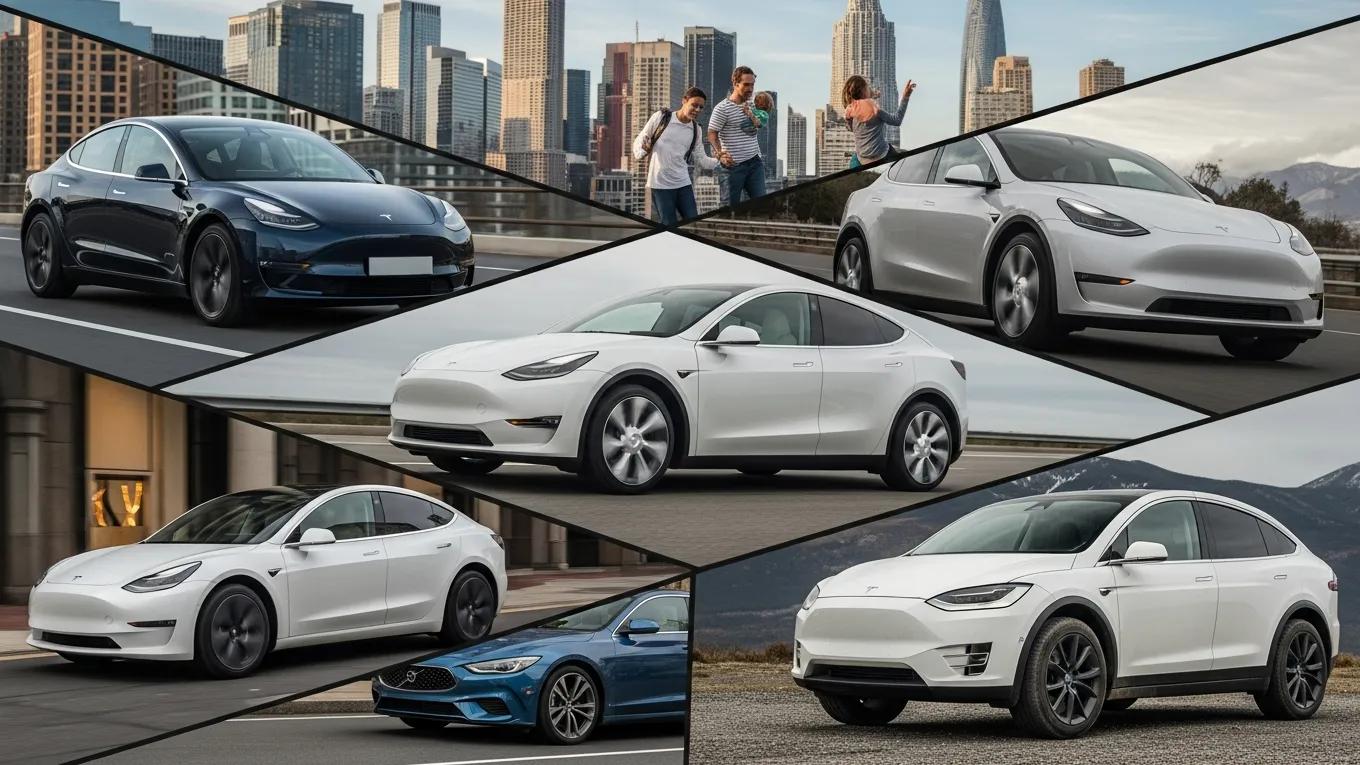
Tesla’s current passenger vehicle line comprises the Model 3, Model Y, Model S, and Model X. The Cybertruck remains in pre‑production with deliveries expected to commence in the near term but not yet started as of mid‑2024. Each model addresses distinct buyer priorities: Model 3 for compact, efficient commuting; Model Y for crossover practicality and family use; Model S for high‑performance luxury; and Model X for full‑size SUV capability. All models employ a software‑first approach and access the company’s charging and energy ecosystem. When selecting among models, assess primary daily driving patterns and cargo requirements first, then evaluate range and available feature packages to match operational needs.
H3: How do Model 3, Model Y, Model S, Model X, and Cybertruck differ in range and features?
Range and features are configurable and vary by trim, wheel choice, and optional equipment; buyers should treat these attributes as adjustable rather than fixed. Sedans such as the Model 3 and Model S prioritise aerodynamic efficiency to maximise range per unit of battery capacity, whereas SUVs and the Cybertruck prioritise interior volume, towing capacity, and cargo utility. Common interior characteristics include a central touchscreen, minimalist controls, and continuous software updates; luxury trims add higher‑grade materials and performance variants focus on acceleration and track‑oriented dynamics. Define whether range, acceleration, cargo capacity, or towing capability is the primary objective to select the appropriate model and package for real‑world use.
- Range versus utility: Some buyers prioritise maximum EPA range; others accept lower range in exchange for towing and cargo capability.
- Performance tiers: Performance trims increase acceleration and typically include upgraded brakes and wheels.
- Interior and tech: All models feature a large central display and software‑driven updates; luxury trims offer enhanced materials.
- Practical features: SUVs and the Cybertruck provide increased seating and cargo flexibility for families and work applications.
These trade‑offs lead into the technological components—Autopilot and battery systems—that underpin Tesla’s driving experience and distinguish models in daily operation.
How do Tesla’s core technologies redefine driving?
Tesla’s core technologies combine a sensor‑and‑software approach to driver assistance, advancements in battery and powertrain chemistry, and a centralised software architecture that delivers continuous improvements. Autopilot and Full Self‑Driving (Supervised) constitute the driver‑assistance suite, while battery management, thermal control, and pack design govern range efficiency and longevity. The in‑vehicle experience is centred on a large touchscreen and a connected Tesla App that jointly manage navigation, energy, and charging functions. Understanding these systems clarifies the operational benefits owners observe in efficiency, convenience, and evolving functionality.
- Software‑first delivery: Features and refinements are delivered over‑the‑air to improve vehicles after purchase.
- Integrated energy management: Vehicle energy systems interface with charging networks and home storage to optimise charging.
- Electric drivetrain advantages: Instant torque and reduced mechanical complexity lower many maintenance requirements compared with internal combustion vehicles.
Next, Autopilot and Full Self‑Driving (Supervised) capabilities are examined in greater detail, followed by an analysis of battery advances that determine practical range.
H3: What are Autopilot and Full Self-Driving features?
Autopilot and Full Self‑Driving (Supervised) are driver‑assistance packages that automate select driving tasks while requiring continuous driver supervision. Core functions include assisted lane keeping and steering, automatic lane changes, Autopark for automated parking maneuvers, Smart Summon for low‑speed vehicle retrieval in parking areas, and route guidance when Navigation on Autopilot is active. These functions depend on the vehicle’s onboard sensor suite and ongoing software updates to refine behaviour; drivers must remain attentive and prepared to intervene. Recognising the supervised nature of Full Self‑Driving sets realistic expectations for safety, legal compliance, and daily use.
Further research examines the machine learning approaches that support Tesla’s Full Self‑Driving system.
Tesla FSD: Supervised & Unsupervised Learning
This paper provides a focused study of Tesla’s Full Self‑Driving system, emphasising the supervised and unsupervised learning methods employed within the FSD architecture.
Supervised and Unsupervised Learning in Tesla’s Full Self-Driving (Fsd) System: A Comparative Study, MK VADALIYA
H3: What advances exist in Tesla battery technology and range?
Tesla’s developments in battery chemistry, pack architecture, and battery management systems are intended to increase energy density, improve efficiency, extend usable lifespan, and reduce cost per mile. Enhancements in thermal management and software‑controlled charging profiles protect battery health and mitigate degradation over time, which affects long‑term range retention. For owners, these improvements reduce the frequency of charging stops for routine commutes and increase real‑world efficiency when combined with regenerative braking and route optimisation. Ongoing research continues to raise energy density, enabling longer EPA‑rated ranges and lower operating costs per mile for long‑distance drivers.
Understanding battery characteristics informs charging strategy and ownership economics, and leads into practical guidance on Tesla charging options.
How does Tesla charging work and why does it matter?
Tesla charging spans public high‑power DC charging, destination charging, and home Level 2 charging with optional integration into residential energy systems. The Supercharger Network provides high‑power charging for long‑distance travel and rapid top‑ups, while home charging is the most convenient and cost‑effective solution for daily use. Charging strategy influences trip planning, total cost of ownership, and convenience; pairing home charging with solar and Powerwall storage can reduce grid dependence and smooth charging costs. The following section outlines Supercharger fundamentals and practical guidance for integrating home charging.
- Speed and convenience: Superchargers are configured to add substantial range quickly during long trips.
- Network planning: Station availability affects route selection and timing for extended journeys.
- Home charging parity: Most daily driving can be accommodated by overnight home charging, reducing reliance on public stations.
The table below compares public fast charging, destination charging, and home charging with Powerwall integration.
This comparison clarifies when to rely on high‑power public chargers versus optimising overnight home charging with energy storage.
H3: What is the Supercharger network and charging speed?
The Supercharger Network consists of high‑power DC charging stations designed for intercity and long‑distance travel, allowing Tesla owners to add significant range in shorter stops relative to standard Level 2 charging. Station siting and availability make the network useful for route planning and can reduce extended breaks during travel. Specific power tiers and the time required to add a given range vary by station and vehicle configuration; therefore, plan charging stops around Supercharger locations and allocate time for breaks and vehicle checks. Effective network use requires integrating navigation guidance, scheduling charge sessions, and monitoring station capacity during peak periods.
Efficient use of the Supercharger Network complements home charging and is central to long‑distance Tesla ownership.
H3: How does home charging and Powerwall integrate with Tesla ownership?
Home charging is the principal daily energy workflow for most Tesla owners. A Level 2 charger provides overnight replenishment sufficient for typical commuting ranges. Proper installation and setting conservative charging rates support battery longevity; many owners configure slower nightly charging to preserve state of charge and battery health. Integrating Powerwall enables storage of solar generation or off‑peak grid energy for vehicle charging, provides backup power during outages, and permits load shifting for cost optimisation. Combining home charging with solar and Powerwall yields a resilient, cost‑effective charging strategy that reduces routine grid dependence.
This household‑level integration demonstrates how Tesla pairs vehicles with its solar and storage products to deliver a cohesive residential energy ecosystem.
What is the Tesla ownership experience?
Tesla ownership is built on a connected, software‑driven vehicle platform, frequent over‑the‑air updates that add or refine capabilities, and an app‑centric workflow for remote control and charging management. Owners receive functional enhancements via software, streamlined service touchpoints, and an expanding set of features without routine physical visits. Daily convenience functions—remote climate preconditioning, trip planning, and charging control—differentiate ownership from conventional vehicles. The following paragraphs describe OTA mechanics, the Tesla App, and expected service and reliability considerations.
- Over‑the‑air updates: Deliver new features and refinements to vehicles after purchase.
- Tesla App convenience: Remote control of charging, climate, and vehicle status via smartphone.
- Service model: A mix of mobile service and regional service centres for maintenance.
These ownership attributes derive from Tesla’s integrated hardware‑software approach and influence service delivery options.
H3: How do over‑the‑air software updates and the Tesla app improve ownership?
Over‑the‑air updates permit Tesla vehicles to receive new features, safety improvements, and software refinements remotely, thereby reducing the need for physical service visits to obtain software‑based enhancements. The Tesla App complements OTA delivery by enabling remote vehicle management such as scheduling charging, preconditioning the cabin, monitoring charging sessions, and initiating navigation. These capabilities reduce friction in daily ownership and allow the vehicle to evolve functionally over time, which can improve long‑term operational value. Centralised controls and updates deliver convenience and a defined feature roadmap that differs from conventional vehicle ownership.
The role of remote updates in vehicle functionality and security is an active area of academic and industry research.
Secure Over-the-Air Updates for Connected Vehicles
Current trends indicate that over‑the‑air (OTA) software updates will be widely adopted in connected vehicles. OTA updates enable upgrades to vehicle functionality and bug fixes in embedded software, thereby supporting safety and security improvements.
Secure over-the-air software update for connected vehicles, S Halder, 2022
H3: What is the service experience and reliability expectations?
Tesla’s service model combines mobile service visits for certain repairs and adjustments with regional service centres for more extensive maintenance, offering multiple channels to address owner needs. Maintenance requirements for BEVs differ from internal combustion vehicles—there is reduced routine engine service, but attention to tyres, brakes, suspension, and software updates remains necessary. Owners can reduce downtime by scheduling maintenance proactively via the Tesla App and following recommended charging and tyre maintenance practices. Reliability expectations derive from fewer mechanical assemblies and software remedies, but occasional service interventions should be anticipated and mobile service used where available to limit disruption.
Proactive planning for maintenance and deliberate charging practices help maintain convenience and vehicle uptime throughout the ownership lifecycle.
How does Tesla integrate energy with transportation?
Tesla situates its vehicles within a broader energy ecosystem that includes Solar Panels, solar shingles, Powerwall residential storage, and Megapack grid‑scale storage to coordinate generation, storage, and consumption. Pairing vehicles with rooftop solar and Powerwall permits shifting vehicle charging to solar production windows, reducing grid draw and providing backup power during outages. For utilities and large businesses, Megapack supplies grid‑scale storage and services that support electrified transportation at scale. The sections below describe solar options and storage roles and include a comparison table mapping products to common residential and commercial use cases.
The energy integration objective is to lower charging costs, improve resilience, and align transportation charging with sustainable energy generation.
H3: What Solar energy products complement Tesla cars?
Solar panels and solar shingles are the primary on‑site generation options to offset vehicle charging demand with renewable energy. Conventional solar panels are arrayed on typical roofs, while solar shingles integrate generation into roofing material for a distinct aesthetic. Appropriate array sizing depends on daily mileage, available roof area, and regional insolation; owners with high charging demand should consider larger arrays or supplementary storage to maximise self‑consumption. Solar generation reduces daytime grid dependence and, when paired with Powerwall, allows charging to be shifted to solar‑rich periods or to provide backup during grid outages.
Sizing and integration considerations lead naturally into a comparison of residential Powerwall and utility‑scale Megapack storage.
H3: How do Powerwall and Megapack support home and business energy needs?
Powerwall is a residential energy storage product that stores solar generation or grid energy for backup power and load shifting; it can supply vehicle charging during favourable tariff windows or maintain charging capability during outages. Megapack addresses grid and large‑business requirements by providing large‑scale storage capacity for load shifting, frequency response, and backup resilience. Matching storage scale to use case—Powerwall for homes and Megapack for grid‑scale applications—enables optimisation of charging costs, improved reliability, and increased integration of renewable energy into transport charging profiles.
For readers prepared to proceed, schedule a test drive, review ordering procedures, and consult Tesla, Inc.’s official channels for product availability; Tesla’s stated mission to accelerate the world’s transition to sustainable energy informs its vehicle and energy product development, and the company maintains a corporate presence in Austin, Texas.
This guidance connects model selection, charging strategy, and energy integration into concrete next steps for buyers and technical stakeholders.
Frequently Asked Questions
What are the benefits of Tesla’s over-the-air updates?
Over‑the‑air (OTA) updates enable Tesla to deliver new features, performance improvements, and safety patches directly to vehicles without requiring a service visit. This reduces downtime, ensures vehicles receive security and functional updates promptly, and can preserve operational value by keeping software current over the vehicle lifecycle.
How does Tesla’s Autopilot differ from Full Self-Driving?
Autopilot is a driver‑assistance system that automates specific tasks such as lane keeping and adaptive cruise control while requiring continuous driver supervision. Full Self‑Driving (FSD) offers a broader set of automated capabilities, including automatic lane changes and navigation on autopilot, but remains supervised and requires the driver to be attentive and ready to assume control. Differentiating these systems clarifies realistic operational and legal expectations.
What charging options are available for Tesla owners?
Tesla owners may use the Supercharger Network for high‑power DC charging on long trips, destination chargers for local top‑ups at hotels and venues, and home Level 2 chargers for routine daily charging. Integration with solar generation and Powerwall permits charging from on‑site renewable energy and storage, which can reduce operating costs and grid reliance.
How does Tesla’s energy ecosystem benefit vehicle owners?
Tesla’s energy products—solar panels, solar shingles, and Powerwall—allow owners to generate and store renewable energy to support vehicle charging. This reduces grid consumption, offers backup capability during outages, and can lower long‑term energy costs when systems are sized and operated appropriately.
What should potential buyers consider when choosing a Tesla model?
Buyers should assess specific operational requirements such as daily driving distance, cargo and seating needs, and performance preferences. City commuters may prioritise the Model 3 for efficiency and cost; families may favour the Model Y for space and versatility. Understanding range, available features, and configuration trade‑offs will support an informed selection aligned to actual driving patterns.
What is the expected service experience for Tesla owners?
Tesla’s service model combines mobile service for minor repairs with regional service centres for larger maintenance tasks. BEV maintenance differs from ICE vehicles, with fewer routine engine services but continued attention to tyres, brakes, and software updates. Owners can schedule service through the Tesla App to minimise downtime and manage maintenance proactively.
Conclusion
Selecting a Tesla electric vehicle supports lower‑emission transport and provides an ownership experience based on advanced technology and integrated energy options. Models address diverse requirements from efficient commuting to family utility and high‑performance driving, enabling buyers to match vehicle capability to operational needs. Integrating Tesla energy products can optimise charging costs and resilience. Review model specifications, evaluate charging and energy integration options, and schedule a test drive to validate the best fit for your requirements.